|

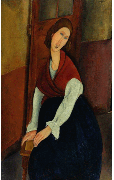
madeo Modigliani was a good painter, not a great one. He didn't have the breath-taking, explosive color madness of Van Gogh or the eclectic, mind-boggling genius of Picasso. He was a good painter
like a 1000 others in the 20th century. He died in 1920 at the age of 35 from alcoholism, drug addiction, tuberculosis, and above all, self-endowed poverty. Two days later, his pregnant wife and the model
for his last painting, Jeanne Hébuterne, jumped to her death out of despair.
Since then, his work has become a commodity and his life-story the fairy-tale fodder of the "Myth of the Starving Artist" (most recently:
last year, an awful film by Mick Davis)
When he first came to Paris, Modigliani met the young Picasso who was in, what the pedants call, his "blue period." Blue vs. ashen-gray
evidently clashed and ran off in divergent directions – Modigliani to a roach-ridden attic where he died, unknown and Picasso to a villa
where he became the world's first painter-superstar and died at 91 at his easel.
Àpropos, again last year, Modigliani's last painting was auctioned at Sotheby's for over $31 million dollars. What are we to make of that? Is the painting worth it?
It's a "talking-head" question. Are Jackson Pollack's scribblings à la enema worth the fortune some people are paying for them? Are Andy
Warhol's dilettante offerings worth the paper they're xeroxed on?
The cold fact is that something is worth the price that someone is willing to pay. And that's that!
There is no sublime irony in the image of a "starving artist" now
revered and groped by a Japanese billionaire industrialist or an American millionaire stock-broker. There is only the sticky coating of mooning, masturbatory consumerism. So what are we to make of that?
In America, the arts traditionally have had a secondary, often peripheral role in the society. The European and Asian flower of
patronage, both state and private, didn't fully blossom in the Protestant work-ethic and "manifest destiny" of the U.S. Anal-retentive
in sex, anal-retentive in art... that was the comforting anxiety all wrapped up in red, white, and blue. It hasn't changed. But what has changed is the perspective of the merchandisers. Once they ogled
the arts and artists as commodities, all joyous, profitable hell broke loose. Art, including the performing arts, became mouth-watering inventory for selling, buying, and collecting.
The frenzy is no longer inspired by the question, "Who will sell this for me?" Now, the query of motivation is, "How can I make someone sell
this for me?", or better, "How can I make someone buy this?" It is the simple driving force of consumerism, amplified in the U.S. and now, in
this Age Americana, spread across the global village like McDonald's butter. Disposable, discardable, here tonight, gone tomorrow morning.
Everyone is a painter, everyone is a writer, a filmmaker, a dancer, a musician, an artist. Anything is art and art is anything.
The tragedy of Amadeo Modigliani was that he met the Blue Picasso and not the Gold one. If he lived today, and painted as he did then
(which he probably wouldn't), he might still be a self-destructive addict but he wouldn't be poor. And what do we make of that?
I'll be interested in your answer to any of the above profundities, or your opinion or comments. Just send them along via this magazine's
nifty "Contact" channel. But, be sure to attach a check for $20 dollars. My apology, I too have been mooned.
|