Aeschylus In Japan
An Interview with
Yuko Senga
by
Lia Beachy


‘In my childhood, one summer afternoon, I was running around the hills and fields, then I was lost… the smell of weeds and the sky… Blue of the sky. Red of the earth… far away I hear the laughter of the gods.” -Yuko Senga
 uko Senga is an actress, director, producer, writer, and the founder of the Yuko Senga
Unit.
uko Senga is an actress, director, producer, writer, and the founder of the Yuko Senga
Unit.  She is also a member of the Japanese Center of I.T.I. (International Theatre
Institution) an organization for theatre artists. She joined the Waseda Theatre (SCOT) led by Tadashi Suzuki, in 1966, and struck out on her own in 1982. Her productions are mainly staged in Tokyo, but she has
worked in avant-garde theatres all around Japan and has taken her company to India, Romania and Korea. She teaches voice and movement at the Asahi Cultural Center in Tokyo and regularly holds
workshops throughout Japan using the text of the famous Japanese classic, “The Tales of Heike. This year she was invited to be the first guest instructor at a new theatre school in Yamagata established by
Hisashi Inoue, a famous Japanese novelist and playwright.
She is also a member of the Japanese Center of I.T.I. (International Theatre
Institution) an organization for theatre artists. She joined the Waseda Theatre (SCOT) led by Tadashi Suzuki, in 1966, and struck out on her own in 1982. Her productions are mainly staged in Tokyo, but she has
worked in avant-garde theatres all around Japan and has taken her company to India, Romania and Korea. She teaches voice and movement at the Asahi Cultural Center in Tokyo and regularly holds
workshops throughout Japan using the text of the famous Japanese classic, “The Tales of Heike. This year she was invited to be the first guest instructor at a new theatre school in Yamagata established by
Hisashi Inoue, a famous Japanese novelist and playwright.
I caught up with Yuko Senga, via e-mail, while she was rehearsing Yuko Senga Unit’s adaptation of Aeschylus’ Oresteia premiering on September 27, 2001 in Tokyo, Japan. Kyoko Hasegawa translated Yuko Senga’s words.

Lia Beachy: Why did you choose to adapt the Oresteia?
Yuko Senga: There are mainly two reasons. The primary role, the most important role, in theOresteia is the chorus and their energy. Because the Chorus plays such an important role, it seems possible to make lots of “spaces” into which I could put in many elements of a modern play. And I thought the way the story grasps the foolishness of human beings is interesting to express as a contemporary play. Also, how they end the trilogy is different from other Greek drama. It is a happy ending and the beginning of a new age in which we don’t know if there is a hope or a bright future ahead only that the gods and the people are convinced that they have to start all over again. That is why if I create this story as a modern play, we can face our own problems.
LB: Do you mean you want a modern audience… a modern Japanese audience, to relate this play to current day issues?
YS: I would like to propose the question to the audience "How should we live?" That is our problem and it has been the problem of human beings throughout history. The 20th century was the century of development. Everything became convenient for human beings, but at the same time we have destroyed ourselves. We have been killing the Mother Earth; we are committing suicide through wars and using up our resources. There is more despair than hope. So what should we do now? “Don't we have to begin again? Don't you think so?" that is what I would like to say to the audience, and I hope that they get my message through the Greek tragedy.
LB: How do you see ancient Greek drama compared to ancient Japanese drama?
YS: Ancient Greek drama/Greek myth is very similar to ancient Japanese myth. But the idea of "contract with gods" is something the Japanese do not have. The Japanese promise to gods, but never contract. Probably because Westerners have been more pragmatic. But human-like gods are similar and the successions of the gods (how the power of each generation of gods is passed over) are similar.
LB: How does Greek drama survive the translation into Japanese?
YS: Although the Japanese know the images or basic story of some of the Greek drama such
as "Trojan Woman" and use phrases like "Oedipus complex" in our daily life, oddly enough not so many of them read Greek drama. Of course we have all the Greek drama translated into Japanese. Many of us think it is the o rigin of Western civilization and is very noble. But theatre, unlike music, does not bear closely on the
needs of ordinary people. All I can say is that Greek drama does have a great influence on people who associate with theatre or like theatre.
rigin of Western civilization and is very noble. But theatre, unlike music, does not bear closely on the
needs of ordinary people. All I can say is that Greek drama does have a great influence on people who associate with theatre or like theatre.
LB: Are you performing all three plays from the Oresteia: Agamemnon, Choephori, and Eumenides in one evening?
YS: Yes, but not word by word. I follow the story as it is but the three plays together are too long, so I extract some sections from the story, make it shorter and then adapt it to a modern play. The duration will be about 3 hours, I think.
LB: Is the Oresteia the first ancient Greek play you've produced?
YS: Yes. This is my first time as a director and producer, but as an actress, I was in Euripides’ Trojan Women as part of the Chorus, when I was a member of SCOT. Also I was in an adaptation of Sophocles’ Oedipus Rex as Jocasta, which was an international collaboration produced by Juksan M-camp Theatre Project I and directed by the Korean director, Kim A-ra.
LB: Which role will you play in the Oresteia?
YS: The wife of Agamemnon, the queen Clytaemnestra.
LB: You mentioned you were a member of the Waseda Theatre (SCOT). Describe that company and the kind of work you did.
YS: I joined SCOT right after it was established and I was 24 years old. I was there for 10 years as an actress and worked administratively as well. SCOT was one of three new,
important and so-called “underground theatres” along with Jokyo Gekijou’s Situation Theatre and Black Tent [Theatre] These three companies changed theatre in Japan with their
experimental plays. I believe SCOT was the best among them. The director was Tadashi Suzuki and the writer was Minoru Betsuyaku. We arranged very Japanese themes into more
universal styles and tastes. Our plays were very dramatic. Besides Japan, we performed throughout Europe in Germany, France, Italy, Portugal, and Holland to name a few.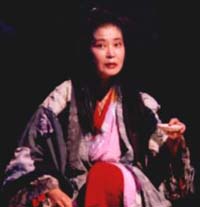
LB: How you have prepared this new production... how long have you been developing and rehearsing?
YS: I started to conceive the structure of this play in December 2000, and we started rehearsing in January 2001. We created original music for this work. The musicians are Kenichi Takeda, the electric Japanese Taisho harpist, and Sachiko Nagata, the percussionist. They will be onstage throughout the performance. I finished the first draft of the script in March, but the text is still being modified. The actors are not given the complete play in advance. They are only given a part, and then they improvise a scene with the main method I use for training and rehearsals.
LB: So how do you work with your actors? Do you train as a company?
YS: Yes. We do a method called "Hyakurai", training ourselves in both voice and movement. It is like chanting. While we chant, we repeatedly stand up and sit down on the floor. The method I use is very abstract but strongly focuses the person who does it. After we chant, we do nothing and think nothing. Then a theme, for example a word, a situation, a voice and physicality, is given to the actors.
 |
LB: Any new projects in development besides the Oresteia?
YS: On Nov. 25 and 26, I will participate in the Kiryu Festival and perform "The Night of Women" based on different Greek tragedies. On Nov. 27, I will do a solo performance in Inadanni, Japan. Next year, I will tell the story of "Kenrei Monin", a part of The Tales of Heike. And, I will collaborate with a musician at "Words Exhibition of Taro Okamoto".
LB: Who are your favorite Greek characters?
YS: Cassandra and Clytaemnestra.
LB: When you are not working, what do you like to do to relax?
YS: Right now, I do not have any time to relax. But I love to go see exhibitions of paintings and sculpture. Also, if I have time, I love traveling to the countryside where I can see old buildings such as temples and shrines in their natural environment.
LB: Does anyone else in your family perform?
YS: No. But my mother is a real woman of culture, and she has been always painting, doing many traditional craft arts. Also when I was a child, she always told me stories. So I believe her influence is a large part of my creativity and imagination.
LB: What are some of your favorite productions or pieces of literature?
YS: I liked "Maharavata" which I saw in India about 10 years ago. A famous company from Southern India performed it. I love the writings of Marguerite Duras [1914-1996]. And of course I always enjoy the works of the Korean director, Kim A-ra.
LB: Who are some of your favorite performers in the world?
YS: Tatsumi Hijikata [1928-1986], the famous Butoh dance master and Melina Merkouri [1925-1994], a famous Greek actress who was appointed the Greek Minister of Culture in 1981.

ORESTEIA
by Aeschylus
Directed by
Yuko Senga
Conceived by Yuko Senga, Toshiya Sekii
Composed by Kenichi Takeda
Set design by Souichi Yoshikawa
Costume design & props by Taki Okajima
Costumes by Yuki Yamaguchi, Mari Tsujimoto
Lighting Design by Takayuki Tsujino
Visualist TAO, Genta Tamaki
Sound by Riha
Stage Manager: Eiji Torakawa
Production Managers: Kyoko Hasegawa, Emiko Yokoyama
Music by
Toko Aida, Yoshino Kidate, Maiko Kiyohara, Kinuyo Sekine, Rie Takeuchi, Kenichi Takeda, Sachiko Nagata
Starring: Man Uno, Taijirou Tamura, Noboru Ryu, Osamu Naoi, Hitoshi Ikeda, Gyu Yonezawa, Akira Hirashima, Tomimasa Kikuguchi, Toko Ejima, Mika Tsuboi, Naomi Saotome Noriko Takeuchi, Yuko Senga, Wakako Sato, Natsu Mizuki- Yuko Horiuchi, Yuko Kinoshita
©2001 Lia Beachy


Lia Beachy is an actor, actress, and jounalista


..

All articles are archived on this site.
To access the Archives .
© 2001 Aviar-DKA Ltd. All rights reserved (including authors’ and individual copyrights as indicated). No
part of this material may be reproduced, translated, transmitted, framed or stored in a retrieval system for
public or private use without the written permission of the publisher and the individual copyright holder.
For permissions, contact publisher@scene4.com.
.
 |
 |
 |
 |
 |
 |
 |
 |
 |
 |

Winter 2001