|
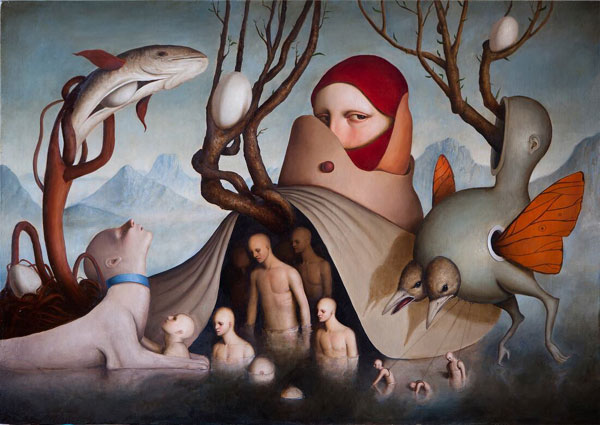
Alessandro Sicioldr, The Birth, 2018
The emptiness that is space shows no sign of disturbance.
Space is, for there is no way for it not to be, yet no line divides
what is from the depths of the nonexistent. In this next to
nothing, there is resonance; there is the hum of every
incantation from past worlds. Each terror is an egg in the
hand of a blind magician. Each neurotransmitter is a key that
fits the lock of a missing door. Once, the Kundalini hid its
teachings inside forms, as a test of whose skill in camouflage
they served and from whose potency they had been created.
We must later on help to free these teachings from their
forms. We must break the Sumerian seal turns us back from
the catastrophic depths of our own breathing.
Having once been set in motion, the Kundalini stirs up and
expels a volcanic flux of images, as it burns through every
obstacle in its path. It rips continents like sheets of paper. It
dismantles the prosthetic bodies of the gods. It unravels all of
the complexes that defend us from our fears, leaving no
means by which blessing can be sorted from disaster. It
expunges every trace of the antediluvian records, all arts and
sciences, yet without even a small detail being lost. “But why
is this necessary?” you might justifiably ask. It is possible that
it does things just to show us that it can. It is possible that the
Kundalini simply likes to play. Or, alternately, it is possible
that our childhood is over, and that, finding ourselves cold
and naked on the coast of a dead ocean, we must figure out
how to grow up.
Tertullian writes, “I believe in the Resurrection because it is
impossible.” So too, at the tail-end of the Kali Yuga, if access
to our first mode of vision would now seem to us impossible,
it is for this reason that we must treat our abandonment as a
test. Good vision may depend on our having nothing to lose,
no cause to advance, no belief whose planks have not been
shattered by a storm. At some point, cooling down, upon
finding that there are no laws left to violate, the Kundalini
may become much nicer than it was. Then, as smoothly as a
bell tone through the zodiac or as the arcing of a current
through the ocean, it will move on to its predetermined end.
Each atom will have 108 eyes.
We do not always have to be picked up and transported to
view one dimension through the wide eyes of another. A state
of clarity will sometimes to the trick. To be present may be to
calmly view the day that we have died, a day that has not
occurred yet. To be present may be to sense how our shadows
too cast shadows, city upon city, length upon darkening
length. To be present may be to grasp the pregnant weight of
the unspoken, to internalize the demands of those who do not
yet exist, to recall the thousands of perfect poems that no
human will ever write. To be present may be to be present in
all the places we have breathed, to remove our metaphysical
chastity belts, to breathe according to the rhythm of our tasks,
no faster and no slower.
To cross from what we know to what we do not know we
know, we may not, in fact, have to move from where we are. A
state of clarity will sometimes do the trick. Then again, to
directly perceive the shifting structure of the cosmos may be
to taste the most potent of entheogens. One’s vantage point
becomes mercurial, no more solid than the drip of Soma on
one’s tongue.
***
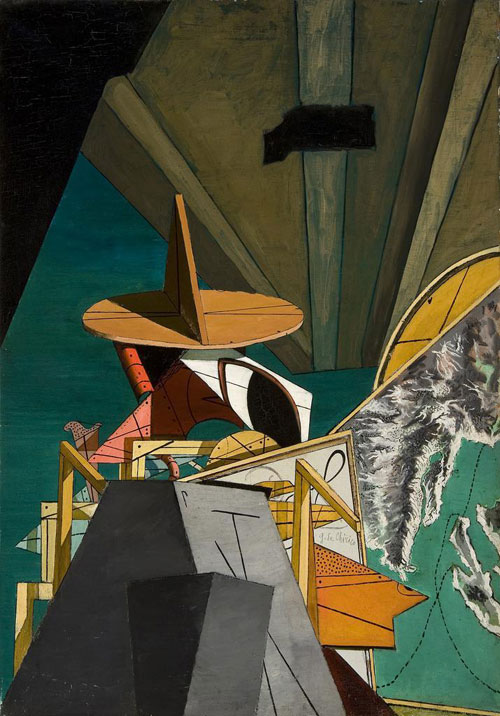
Giorgio de Chirico, The Pirate, 1914
If we desire to reset the parameters of our vision, it will be
necessary to begin at the beginning, like those long-eared
poets who lifted up dead cities with their words. Being silent,
they could hear. Being desperate, they could laugh. Being
present, they could trace the labyrinthine path that they had
mapped out in past worlds. Crossing from one residual
landmass to the next, between those few peaks that still poked
above black waters, those seers joined hands to call the Sun
out of the deep. What they were taught to do, they did. They
caused lost cultures to coagulate beneath them. Their hearts
weighed almost nothing—a bit more, a bit less. Their eyes
were wide. They did not hesitate to kill.
Even now, the long-eared poets play games with the sky. Even
now, you can hear the rhythm of their oars, the drone of their
chant, the slap of their feet as they dance upon black waters.
Even now, they return to the clear shores of their youth.
Curled like fetuses and covered with red ochre, even now,
those poets breathe. Their whispers re-inflate the lung-sacs of
the globe. Their hands still clutch the gifts that they take to
the beyond.
Even now, those seers stare into the Sun, in their hands the
cylinders that hold the eggs of slaughtered species, in their
hands the knives that cut the throats of foreign gods. Like our
guides, we must not only find a way to begin at the beginning,
we must find some way to determine just what a “beginning”
is.
The world is almost infinitely complex, as is time, and human
nature, but we should start by drawing a circle on the ground.
We should lift our hands at the center of a turning 10
-dimensional torus, which can be statistically renormalized as
a circle no more than 10 feet wide. There, we will begin our
invocation. There, we will test the first steps of our dance.
There, we will reach for the others in our circle, for those
present and not present, for those whose phones have no
signal, for those who live in cities where the streetlights have
gone off. We should start there, in this circle, and not
elsewhere, for there is no other place. This circle will be
powered by our breath, and its centripetal vortex will then
gather up what it needs.
Visions will be allowed to visit, but fears and traumas and
hatreds and projections will be required to stay a few feet off.
Joining hands, we will cross from one residual landmass to
the next, from coast to shifting coast, between the sites of the
derelict reactors. We will lose track of our tears. We will feel
our earlobes grow. As the invocation swells, a standing wave
will lead us to the center of the Sun, inside of which are cities.
A standing wave will lead us to the Sun behind the Sun, to the
twin that so few know. A standing wave will lead us to the belt
stars of Orion, and then into the trials beyond.
Back home, there will be few remaining traces that there ever
was a circle. A new Sun will have long since bubbled from the
depths. We will find, should we return, that our bioenergetic
vehicles have been transformed into stones. At first
worshipped by the masses, they will later come to be seen as
normal parts of the environment. In passing, we will note that
a day takes 24,000 years. Hieroglyphs will buzz in geometric
networks. In our reconfigured forms, we will take what we
require, no more and no less. We will improvise as we go.
***
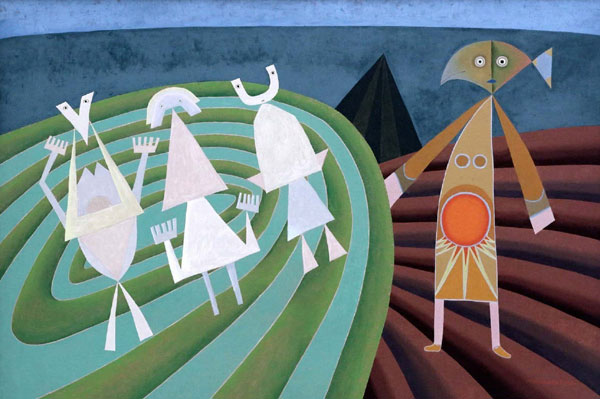
Victor Brauner, Prelude to Civilization, 1956
In the end, it is predictable that any prophesy will fail, for the
omniverse is far more contradictory than a clock. And, though
we can envision this omniverse as a being with two hands, it is
in no way obligated to use just the hands that we can see.
Then too, of necessity, some chaos must always be added to
the mix. In order to get from where we are to the sphere we
once inhabited, we must set foot on a path that does not exist,
in those bodies that we threw so carelessly about. What we
once saw, we must see. We must excavate our ears. We must
learn to pronounce the words that we once spoke. We must
harness the explosive power of the zero. We must dare to
follow the instructions that we left. With our small flutes, we
must challenge the bone orchestras of the Empire.
|