|
Filling Station Elizabeth Bishop
Oh, but it is dirty!
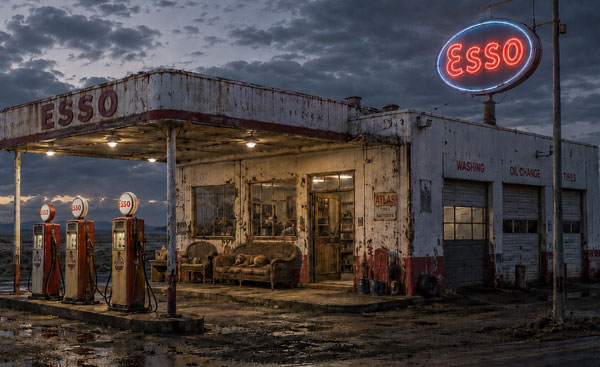
—this little filling station,
oil-soaked, oil-permeated
to a disturbing, over-all
black translucency.
Be careful with that match!
Father wears a dirty,
oil-soaked monkey suit
that cuts him under the arms,
and several quick and saucy
and greasy sons assist him
(it’s a family filling station),
all quite thoroughly dirty.
Do they live in the station?
It has a cement porch
behind the pumps, and on it
a set of crushed and grease-
impregnated wickerwork;
on the wicker sofa
a dirty dog, quite comfy.
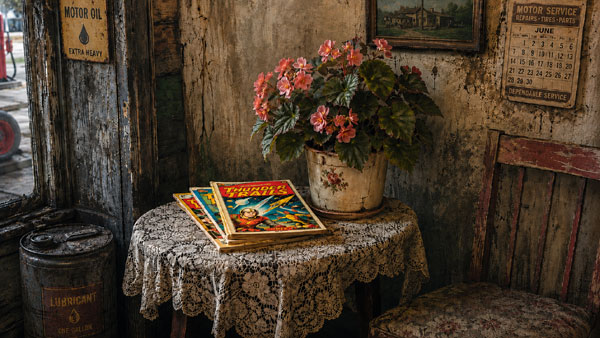
Some comic books provide
the only note of color—
of certain color. They lie
upon a big dim doily
draping a taboret
(part of the set), beside
a big hirsute begonia.
Why the extraneous plant?
Why the taboret?
Why, oh why, the doily?
(Embroidered in daisy stitch
with marguerites, I think,
and heavy with gray crochet.)
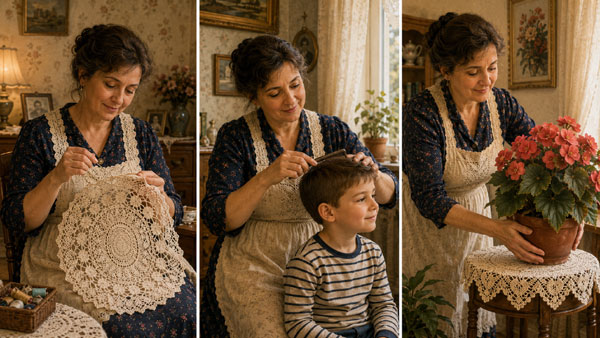
Somebody embroidered the doily.
Somebody waters the plant,
or oils it, maybe. Somebody
arranges the rows of cans
so that they softly say:
Esso—so—so—so
to high-strung automobiles.
Somebody loves us all.
The first thing to notice about the opening line of Elizabeth Bishop’s
“Filling Station”is its curious tone, which I think can best be described
as one of affectionate shock and awe. Bishop’s speaker sounds like a
meticulous spinster aunt who, dropping in on her sister’s family, is
surprised to come upon a nephew who has been playing in the mud. Of
course she loves the child, but “Oh,” how can anyone be so “thoroughly
dirty”?
But our speaker is not visiting relatives. She’s where she is because she
has a flat tire or an empty gas tank. She needs help from whoever runs
this filthy filling station. Nor is she the only stranger who has wandered
into this “oil-soaked, oil-permeated world,” one that is not only dirty,
but dangerous. She notices that you, reader, are lighting up a cigarette,
and urges you to “Be careful with that match!”Alas, as with planet
earth, carelessness could blow this little world to smithereens!
Inside the station now, Bishop turns our attention to its owner. “Father
wears a dirty, / oil-soaked monkey suit”and several
“
greasy sons assist
him.” Bishop makes us feel like visitors from another planet exploring
an alternative universe
.
Our mission is to try to understand a world, so
different from the clean one we will return to, once our tank has been
filled with gas or our crankcase with oil.
Now that we are over our shock, Bishop invites us to contemplate
mysterious artifacts that fill her with awe. Within the “over-all/ black
translucency”of this station we notice comic books that
“provide the
only note of color— / of certain color” in what is the family living room.
“They lie / upon a big dim doily.”
Having seen its oily father and saucy sons, our poet knows this is “a
family filling station.” It should be obvious to her that the owner’s wife
embroidered the once bright, now dim “doily.”She probably expects us
to notice the word “oil” is contained in doily. It should also be obvious
that mom “waters” or “oils”the “big hirsute begonia” in an attempt to
sustain beauty in this strange family home
Bishop, however, has been nudging us ever so gently, almost comically
towards the possibility of a metaphor wherein this dirty gas station
implies the universe we all live in. To continue to tweak that potential
trope she poses the metaphysical questions Why do such decorative
items appear in such a dim, dreary setting and Who or what entity
could have created and placed them there?
Why the extraneous plant?
Why the taboret?
Why, oh why, the doily?
(Embroidered in daisy stitch
with marguerites, I think,
and heavy with gray crochet.)
Somebody embroidered the doily.
Somebody waters the plant,
or oils it, maybe. Somebody
arranges the rows of cans
so that they softly say:
Esso—so—so—so
to high-strung automobiles.
The mother, aunt, or grandmother literally responsible becomes an
unidentified “Somebody” referred to multiple times whom Bishop
places firmly offstage. She may be thinking of the cliché for a
VIP—He’s a real Somebody—or the then popular Gershwin song
“Somebody Loves Me” which begins:
Somebody loves me, I wonder who,
I wonder who he can be.
Somebody loves me, I wish I knew,
Who can he be worries me.
Most of us would probably like to believe, re the argument for Design,
that there is a benevolent somebody behind the world of good and evil
that we find ourselves in. Although our poet nudges her words towards
that conclusion, her first four Somebodies resist, pointing merely to
human beings embroidering doilies, watering plants, and arranging
Esso cans to remind “high-strung automobiles”that they need oil, as
well as gasoline, to continue to operate smoothly.
Then, suddenly, with her final line Bishop makes a bold leap,
transforming her earthbound somebodies into the creative power she
has been sidling towards, tongue in cheek, all along:
“Somebody loves us all.”
There’s nothing mysterious or grandiose about a mother trying to
beautify a makeshift home. But a mother’s urge to do so suggests that
the love that inspires her may be the result of a directive inserted into
the structure of the universe itself. An entity capable of loving us all
would be a real Somebody!

Philosophers and scientists mostly agree that their greatest
unanswered question has always been: Why is there something rather
than nothing? Theologians answer it with Because an active God or
First Mover has willed things—including us—into existence. Bishop’s
final “Somebody loves us all” is so vast, so inclusive, that it sounds
more like a leap of faith not towards the fallible, but towards the
immortal and divine.
Bishop was an admirer of Wallace Stevens, so I’m going to close with
his poem “The Well-Dressed Man with a Beard.” Although Stevens’
poem appeared more than 25 years before Bishop’s, he expresses the
same human urge to affirm life that she playfully tries to fill our spirits
with in “Filling Station.”
After the final no there comes a yes
And on that yes the future world depends.
No was the night. Yes is the present sun.
If the rejected things, the things denied,
Slid over the western cataract, yet one,
One only, one thing that was firm, even
No greater than a cricket’s horn, no more
Than a thought to be rehearsed all day, a speech
Of the self that must sustain itself on speech,
One thing remaining, infallible, would be
Enough. Ah! douce campagna of that thing!
Ah! douce campagna, honey in the heart,
Green in the body, out of a petty phrase,
Out of a thing believed, a thing affirmed:
The form on the pillow humming while one sleeps,
The aureole above the humming house . . .
It can never be satisfied the mind, never.
Like Stevens, Bishop knows that the self “must sustain itself on
speech.” “Out of a petty phrase, / Out of a thing believed, a thing
affirmed”she finds “One thing remaining, infallible”and must accept
“Somebody loves us all” as “Enough.”
|
|