|
As
soon as the Steiny Road
Poet saw (June 2026)
the paperback title In Tangier We Killed the Blue Parrot in Washington, DC’s Politics and Prose Bookstore, she knew the book would feature the love story of Jane and Paul Bowles. What surprised her was that although this work appeared in hard cover in April 2005, she had never heard of it. People who know Steiny are aware that in 1982 she spent three weeks in Tangier in a writing workshop with Paul Bowles as a teacher and mentor. The fact that no one ever mentioned Barbara Adair’s novella to her means that few people saw this book, which was not reviewed by major publications such as the New York Times.
Steiny was in New York
frequently in the
spring of 2005 because
her opera Gertrude
Stein Invents a Jump
Early On with William Banfield premiered there that June. While many of the literati frequent bars, Steiny hung out at book stores and she did not see this book.
Adair’s
novella—the
paperback has 146
pages—is set for
the most part in
Tangier, Morocco in the
1940s and ‘50s.
The opening and
closing, which occur
after Jane’s
death in 1973, frame
the memories of
the fictitious
character Belquassim
(Paul’s male
Moroccan lover). The
story includes many
events that actually
happened—the time
Jane and Paul spent in
the bars of Tangier,
the negotiation to give
Paul’s little
Casbah house to Cherifa
(Jane’s Moroccan
lover), the trip Paul
took to collect
Moroccan music,
Jane’s stroke
that left her blind,
her burial in Malaga,
Spain.

Adair boldly engages her characters in violence that might
have been written by Bowles himself. This occurs in two
scenes with Paul and his boy lover Belquassim. One involves
an attack on Belquassim where a stranger slashes the boy’s
face in an act of pure hatred. Paul is there and does nothing
about it except calmly pay the restaurant bill and usher
Belquassim out. The other is an unprovoked moment where
Paul burns Belquassim’s shoulder with a lit coal of hashish as
he muses over what love versus cruelty is.
After the two opening chapters of omniscient narration
focused on the 35-year-old Belquassim, the characters of Blue
Parrot often speak without clear attribution. Chapter III
opens as follows: I think of myself as a writer now. Although
Adair doesn’t identify the speaker here, this particular
sentence, set in Italics, was referred to in Chapter I when
Belquassim states that he remembers Paul saying this. But
then Paul adds, “Don’t credit me with this observation. It
comes from Bill.” At this point in the story, Adair does not
reveal who Bill is. Steiny recognized him as William
Burroughs, an American writer living briefly in Tangier in the
mid 1950s where, as a completely strung out drug addict, he
wrote Naked Lunch. During an interview which Steiny
conducted with two other writers in Paul’s Tangier
apartment, Bowles stated that he did not have much to do
with Burroughs. He added that he couldn’t understand why
Burroughs was throwing, as he wrote, the only copy of his
work on the floor of the basement apartment where he was
living—a space littered with food, mouse droppings, and dirt
from the garden.
Adair salts her novella with italicized quotations but doesn’t
usually document the source. In her acknowledgements at the
end of the book, she writes:
In the course of writing this novel many writers have been
close to me. I may have used their words: a phrase, a
sentence, a paragraph, some poetry. Readers of this book
will know these words or sentences…; they will know who
wrote them. … I am grateful to all those who are dead and
who have inspired me to love words.
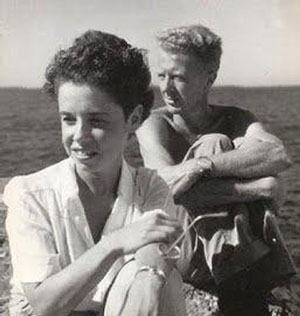
Adair then goes on to thank Jane and Paul Bowles as well as
the pantheon of writers associated with them—such
luminaries as Gertrude Stein, Albert Camus, Jean Paul Sartre,
Allen Ginsberg.
How does Adair get away with this? This is what is called
intertextuality. (Yes, Steiny consulted ChatGPT.) “Rather than
footnoting or identifying every quotation, Adair allows the
voices of other writers to circulate through her novel as
though they are part of the texture of Tangier and the
consciousness of her characters.” She is deliberately capturing
lines from known writers and encouraging the reader to
participate in identifying whose words she has used.
Intertextuality provides a smooth transition between
biography and fiction. It suggests deep connection to writers
of the past and lets the characters speak without interruption
for attribution. Finally, it invites the reader to participate. It’s
all part of Postmodernism.
However, there can be issues with lack of attribution and
copyright if the “borrowed” work is not in the public domain.
Despite the common belief that using a very short quotation
without permission is legal, this is only true for reviews, not
for quotes used in such works as fiction, poetry, and opera
libretti. Many years ago, Steiny interviewed a United States
Copyright Office official on this topic. She made it clear that
legal use of another writer’s words requires permission.
This brings Steiny back to how Adair, a South African, has
gotten away without being sued for stealing the work of other
authors. Maybe her work just flies under the radar and the
estates of the authors whose work has been used without
permission do not have the financial resources to bring a suit
against a book that isn’t a best seller.
Adair has created some inauthentic scenarios in Blue Parrot.
In Chapter V, she has her Paul Bowles wondering where the
name for the Beat Generation came from. "Beat up. the beat
movement. I wonder if that's where Allen got the term from,
beat up, not new." Much of these choppy musings are in
italics but are certainly not from Paul’s polished prose.
Furthermore, Jack Kerouac named that movement, not Allen
Ginsberg. In Chapter XVIII, Belquassim reports that Paul told
him that Gertrude Stein advised him to work when he was
twenty because “no-one” will love you when you are thirty.
Steiny knows that line well—she used it first in her poem
“Birth of a Novel: Paul Bowles Confesses” published in The
Anima of Paul Bowles (Ashville, NC: MadHat Press, 2016)
and later in her work-in-progress opera with Janet Peachey What Price Paradise. In an interview with Philip Ramey
(published in “You Didn’t Want Even to Meet Prokofiev?” In Paul Bowles: Music, pp. 9–28. New York: Eos Music, 1995).
Paul Bowles said, “Aaron [Copland] used to shrug his
shoulders and say, ‘If you don't work now when you're
twenty, no one will love you when you're thirty.’”
Despite Steiny’s criticism, she thinks Adair’s book is an
interesting read with its intertextuality format, its two
instances of violence and the intriguing book title. Steiny
thinks the blue parrot of Adair’s title is the very sad Jane
Bowles who lost her ability to write for a plethora of
reasons—jealousy (of Paul’s male lovers), abandonment (Paul
turned his creative mentoring away from Jane), ill health
(genetically predisposed for heart problems like her father
who died young), and severe alcoholism.
The question is will Barbara Adair’s novella catch the
attention of those who have read Paul Bowles’ novel The
Sheltering Sky, turned in to a block buster film by Bernardo
Bertolucci, or will it languish as a cult work like that of Jane
Bowles’ novel Two Serious Ladies?
|



 Writings