|
Two recent films—Yorgos Lanthimos’ Bugonia and
Phil Lord and
Christopher
Miller’s Project Hail Mary—could
reasonably be described
as inversions of each
other. Bugonia concerns
a man obsessed with the
idea that space aliens
are invading and
destroying Earth, while Project Hail Mary is
about a scientist who
voyages into the cosmos
and makes connection
with a denizen of
another planet.
Knowing that one
film was made by the
director of The Killing of a Sacred Deer, and
the other by the
directors of Cloudy with a Chance of Meatballs, will
tell you the
films’
contrasting levels of
optimism before you
watch a minute of
either.
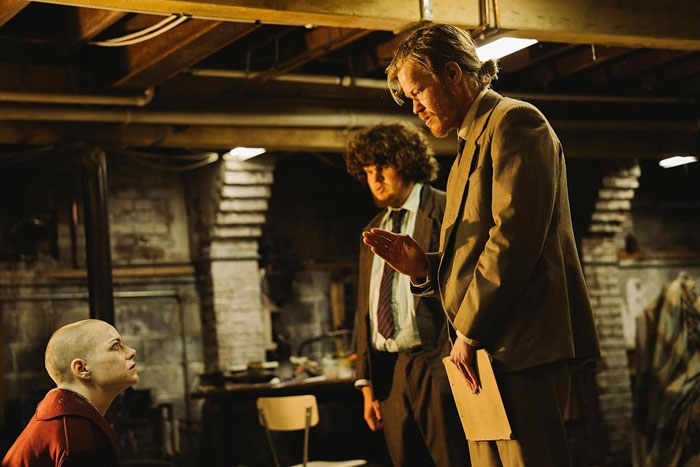
Teddy Gatz (Jesse
Plemons) is a beekeeper
who works in the
shipping department of
a large pharmaceutical
company to make ends
meet. He is close
to no one except his
autistic cousin Don
(Aidan Delbis), who
lives with him on their
farm. At the
beginning of Bugonia (with
a screenplay by Will
Tracy, based on a 2003
South Korean film, Save the Green Planet), Teddy chemically castrates himself, and forces Don to do the same, in preparation for a caper which, Teddy believes, will save the planet.
That caper is the
kidnapping of Michelle
Fuller (Emma Stone),
CEO of the
pharmaceutical
firm. Fuller is
the sort of boss who
thinks that allowing
employees to go home at
5:30—under
certain circumstances,
of course--is the
height of generosity,
so we don’t feel
particularly sorry for
her when Teddy and Don
abduct her.
However, we change our
minds when Teddy shaves
her head, covers her
with antihistamine
cream, and subjects her
to electric shocks.
In Teddy’s
theory, Michelle is an
Andromedan, a
representative of an
alien race that is
killing Earth’s
honeybees and enslaving
humanity. Teddy
has shaved her head and
covered her with cream
to prevent her from
sending signals to the
Andromedan
mothership. There
will be a lunar eclipse
in four days, and Teddy
tells Michelle she has
until then to arrange a
meeting between him and
the leaders of the
mothership.

This qualifies as normal for a Lanthimos movie. This summary
omits a great deal which should not be revealed if Bugonia is to
have its intended impact. There are multiple scenes of violence
and psychological manipulation, as Michelle’s powers of
persuasion collide with Teddy’s fanaticism. There are flashbacks
featuring Teddy’s mother (Alicia Silverstone), which show us how
Teddy got to be the way he is. There are ostensible distractions,
such as the local deputy sheriff (Stavros Halkias) who keeps
apologizing to Teddy for what he did to him when he was his
babysitter.
Bugonia revels in outrage after outrage, concluding with two plot
twists, one more easily foreseen than the other. The movie hits
audiences with Lanthimos’ usual sustained gut punches, but it’s
the performances of Stone and Plemons that make the film
unforgettable. Michelle’s guileful attacks on Teddy’s hermetic
worldview are something to see, as are Teddy’s reactions, which
begin with rage, continue through bewilderment and end in wary
but total acquiescence. Michelle and Teddy, despite their
anomalous situations, are types found all too often throughout
history.
If Bugonia proceeds through descending layers of hopelessness, Project Hail Mary begins with the most hopeless situation
imaginable. Knowing that scenarist Drew Goddard also wrote the
screenplay for The Martian, both based on novels by Andy Weir,
gives you a hunch that things may not be as hopeless as they
seem.
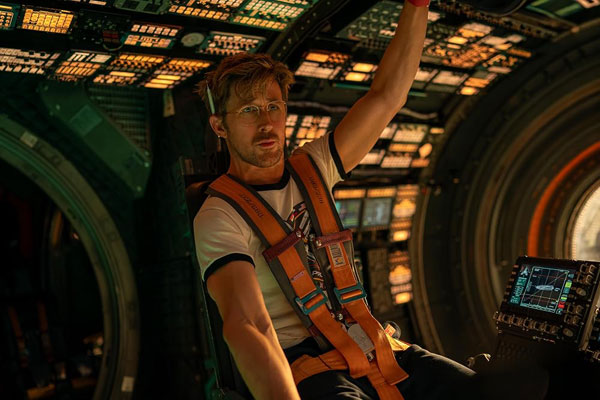
Ryland Grace (Ryan Gosling) wakes from an induced coma on a
spaceship light-years from Earth. He does not immediately
remember why he’s there, or even who he is. He discovers his
two crewmates, both dead.
Slowly Grace recovers his memory. On Earth he was a disgraced
molecular biologist reduced to being a middle-school science
teacher. He was divorced, with no romantic involvements and
few friends. One day government agents led by Eva Stratt
(Sandra Hueller) came calling. It turned out that his “Petrova
Belt” theory, which caused other biologists to dismiss him as a
crackpot, was in fact correct.
Stretching from the Sun to Venus, the Petrova Belt was formed by
microorganisms called astrophages. Astrophages had infected
the Sun and were dimming its surface. Within thirty years, Stratt
said, they would cool the Sun enough to make Earth
uninhabitable.
Astrophages also could serve as a remarkably efficient rocket fuel,
and NASA could harness them to power a space mission to Tau
Ceti, the closest uninfected star, to investigate ways to counter
and destroy the astrophages. This was the last chance
humankind had for survival. The one-way trip took more than
ten years; there was enough astrophage fuel to get the astronauts
to Tau Ceti and to transmit data to Earth, but not enough for a
return home.
This is a suicide mission—and Grace is not there willingly.
How Grace adjusts to his situation is engrossing, albeit mitigated
early on by a sense of doom. Project Hail Mary, however, really
takes off (pardon the pun) when Grace encounters another
astronaut—a half-crablike, half-rocklike creature from the 40
Eridani A system. After the initial shock, the two beings learn to
communicate through machine translation devised by Grace. The
Eridian and Grace cannot survive each other’s atmosphere, so the
Eridian must stay in a pressurized xenonite ball. Grace cannot
begin to pronounce the Eridian’s true name, so he christens him
Rocky.
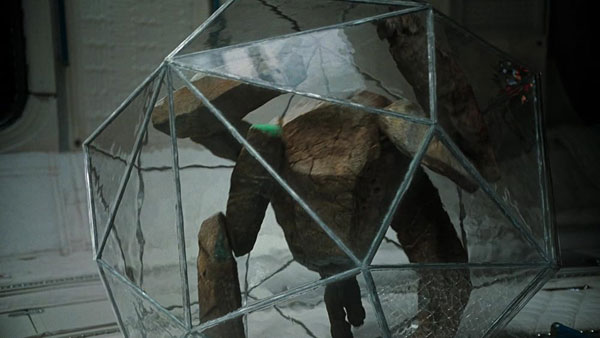
The relationship between Grace and Rocky is the centerpiece of Project Hail Mary; it essentially overrides everything else in the
film, including scenes that are as white-knuckle suspenseful as
anything in any outer-space movie in history. As created and
voiced by actor-puppeteer James Ortiz, Rocky owes a debt to
Yoda, E.T., and any number of space movie creatures. But,
despite his forbidding appearance, he is far more relatable than
any of them. Rocky is not a child’s toy or a Jedi knight. He is,
like Grace, a professional scientist who is trying desperately to
solve a problem that threatens the destruction of his world. His
attempts to use English idioms and Earth concepts with Grace
provide most of the film’s comic relief, but we can only imagine
what Grace sounds like to Rocky. We come to see that Grace and
Rocky are similar, both in intellect and personality. We also learn
that Rocky, like Grace, has suffered the deaths of his shipmates.
In other words, Rocky is lovable, and we come to believe totally in
his reality.
Ortiz’s performance complements that of Gosling, who spends
much of Project Hail Mary acting solo. Grace is no hero at the
beginning, just a man in a perilous situation who must think his
way out of it. The greatest pleasure of Project Hail Mary is
watching Grace grow as a scientist and a man, especially through
his friendship with Rocky. Grace’s ingenuity, as amazing as it is,
takes a back seat at the end to his courage, love, and self-sacrifice.
Bugonia and Project Hail Mary are both well worth seeing, but
the latter will leave you feeling considerably happier than the
former, and also a lot more optimistic about the human race.
Their endings are directly opposed to each other, and I leave it to
you to discover what they are.
|