|
Imagine the hype: Ercole amante (Hercules in Love), a 300
year-old opera
composed by a woman
and never before
fully performed. A
story of sexual
harassment reframed
as a contemporary
sensation because
the composer,
Antonia Bembo (ca
1640-1710), had to
flee her abusive
Venetian husband and
seek shelter in
France, at the court
of Louis XIV. The
hype about a special
connection with the
present-day MeToo
movement made me
wonder where the
numerous damsels in
similar distress of
the classical
repertoire had
suddenly gone: from
Mozart’s Marriage
of Figaro or Don Giovanni to Verdi’s Luisa Miller, Puccini’s Tosca, Stauss’ Salome, Rosenkavalier and so on.
There have been more
women composers
during the Baroque,
especially in
Venice, than is
usually remembered,
but the involvement
of the Roi-Soleil is
part of the
sensation in Paris.
How come Louis XIV
commissioned an
opera from the
fugitive Bembo, an
acclaimed Venetian
singer and song
writer, who was
already in her late
sixties and had
never written an
opera? Moreover, Ercole amante had already been commissioned by him forty-five years earlier. In 1662, acclaimed composer Francesco Cavalli had created the first Ercole amante as a tribute to the young king’s marriage to the Infanta Maria Theres. Why commission a second version from Bembo, who was a student of Cavalli and even used the same libretto? The king, it is said, was interested in a new score that would combine French and Italian styles, something like elegant French coloratura with Italian bel canto legato and rubato. The opera, Bembo’s first and last, was never performed at court. Could it be that it was amusing for the young king to watch an aging hero get caught with his hand in the cookie jar, but less amusing four decades later?
The many mysteries piling up here were caused by the chance
discovery of the score at the French National Library, in 2023.
Conductor Leonardo García Alarcón detected it and was
convinced he had a masterpiece on his hands. But when the
curtain finally went up in Paris at the start of June, not everyone
agreed.
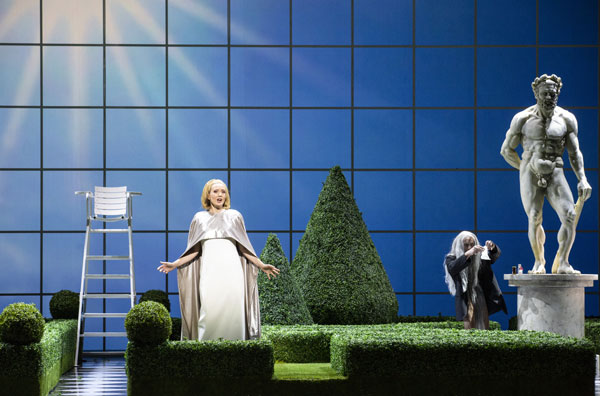
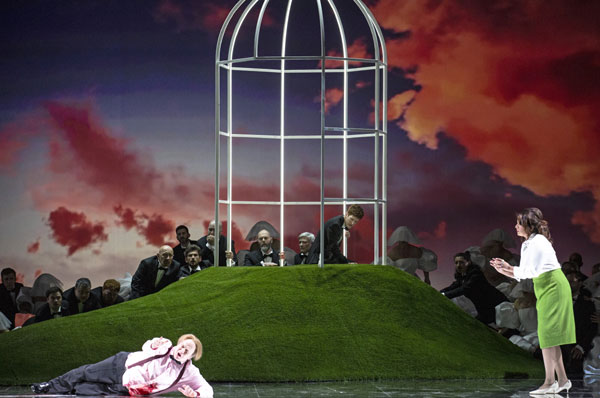
The story is still the same we know from Cavalli. The aging hero
(here in a fat suit and yellow toupée) is tired of his wife Dejanira
and lusts after Iole, the fiancée of his son Hyall. The Goddess
Venus is on his side and helps him with a love potion so the poor
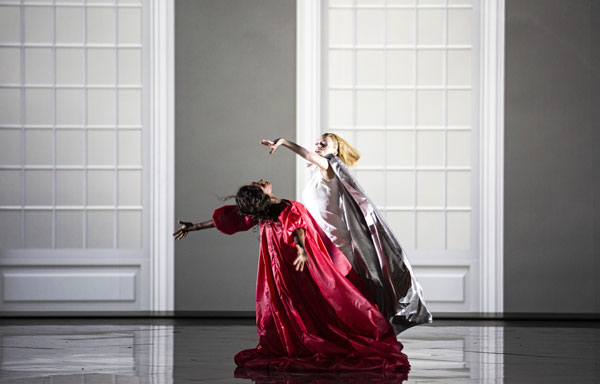
girl ends up saying yes. Now Juno storms in (like Fricka in
Wagner’s Ring) to defend marriage and seek revenge. The clash
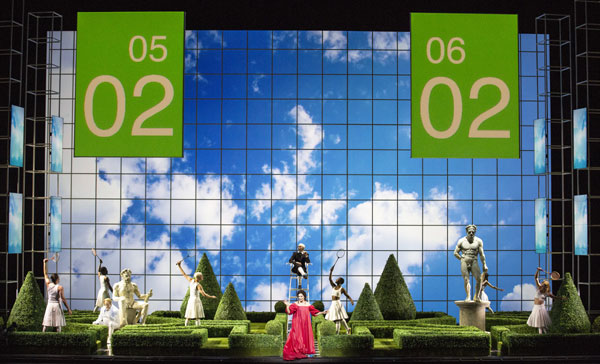
between the Goddesses is illustrated by a catfight between two
dancers. Under Juno’s attack, old Hercules falls like Humpty
Dumpty between the sculpted hedges of his castle. Problem
solved? Not quite. This is only the beginning of five acts almost
four hours. The loyal Hyall saves the father who only wants the
girl more than ever -- and the tug-of-war between gods and
humans can go on. In the end, the preposterous marriage of
Hercules and Iole is thwarted by a poisoned cloak that finally
stops the lusty hero for good.
Iole and Hyall get their happy ending and Hercules gets his
apotheosis: he is unites with Venus and with Beauty (who surely
symbolizes the king’s queen).
Relevant for today?
I heard Leonardo García Alarcón on the TV show “Toi Toi Toi”
play piano excerpts of the score he had discovered. He
demonstrated why the director of the Paris Opera was enthralled
by the project. It seemed clear as a bell: arresting harmonies and
rhythms sounded seductively modern, almost predictive of the
Romantic era. But I never heard this again in the vast, concrete
bunker of the Bastille Opera. My companion, a Baroque
enthusiast, didn’t hear it either. The music seemed swallowed up
by the cavernous auditorium with its complicated acoustics.
It became quickly clear that the conductor and the London
director Netia Jones, who also created the sets, video projections
and costumes, had made a miscalculation when they chose Opéra
Bastille for their world premiere.
The obvious venue would have been the smaller, plush Palais
Garnier. The old opera with its warm acoustics would have
provided the intimacy needed to bring out the subtleties of the
orchestration and, especially, the vocal writing by a composer
who was after all a singer..
Most voices sounded muffled, as if stuck behind a curtain. The
soprano voices seemed disturbingly similar as they forced their
volume to get across the deep pit and the orchestra that the
conductor had stuffed with multiple extra instruments (fifty-some
in all.) The excellent soprano Julie Fuchs as Juno was more shrill
than radiant, and the gorgeous voice of Sandrine Piau as Venus
was caught in a vocal battle she couldn’t win.. The male singers
fared better. Bass-baritone Andreas Wolf as Hercules boomed
well enough but sacrificed beauty of tone. Alasdair Kent as the
son seemed to relish his daunting high tessitura, and
countertenor Theo Imart as the Page had no problem with his
excellent metallic timbre.
Luckily the mellifluous voice of nezzo Deepa Johnny as Dejaniraa came through rather unharmed. She was the only singer who
made an emotional impression, which was no wonder as Bembo
had given the most beautiful laments to her alter ego, the
spurned wife.
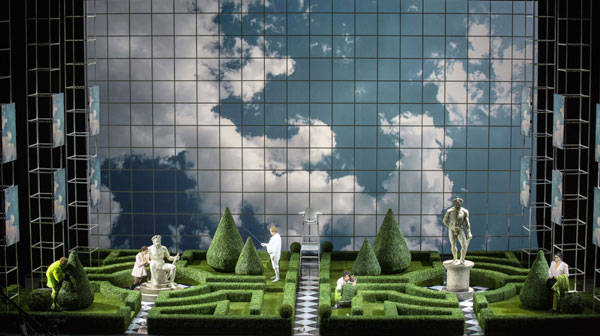
The problems were further aggravated by the director’s need to
fill the vast plateau by spacing out the singers as if to “populate”
the space. Singing across quite an expanse at each other inevitably
watered down their dramatic engagement. It didn’t help that
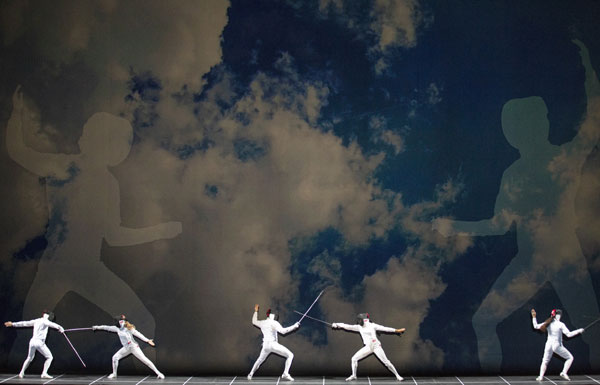
Jones added lots of “filler” movements by dancers, fencers and
servants to the cast. This created entertainment rather than
interpretation or depth. Watching fencers rushing from left to
tight and back again, and Badminton players in the French
garden was very pretty but hardly original. She heavily leaned on
video projections as illustration. The images were undoubtedly
gorgeous, but their themes--mostly skies and clouds and water --
further distanced the poignancy of the central story.
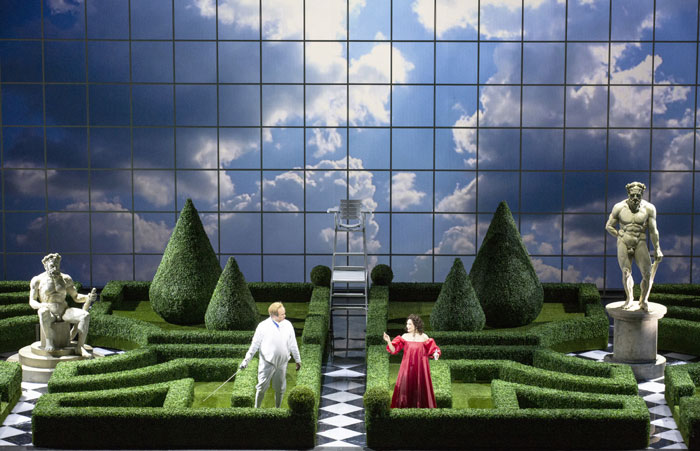
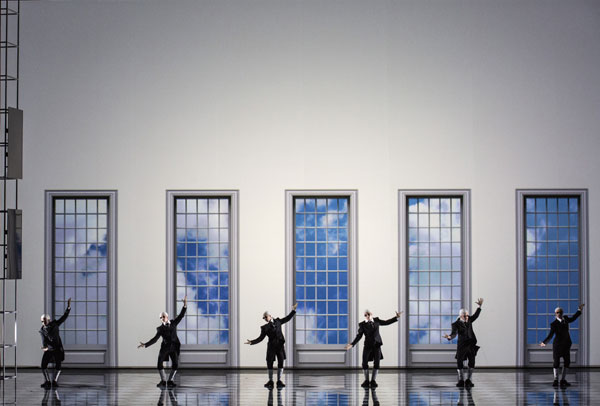
The same distanciation came across in Jones’ bizarre and
occasionally amusing modern costumes. The waiters were
Karl Lagerfeld look-alikes with ponytails and sun glasses. Venus
looked like a stuffed red pepper in a tulle ball gown and Juno, in
slinky white silk, like ready for an opera premiere. The hapless
son wore thick glasses; the male Page scuttled about in a
grotesque lime-green miniskirt and chenille bomber jacket.
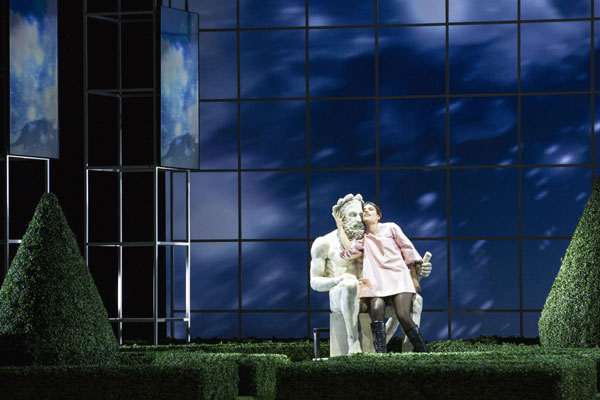
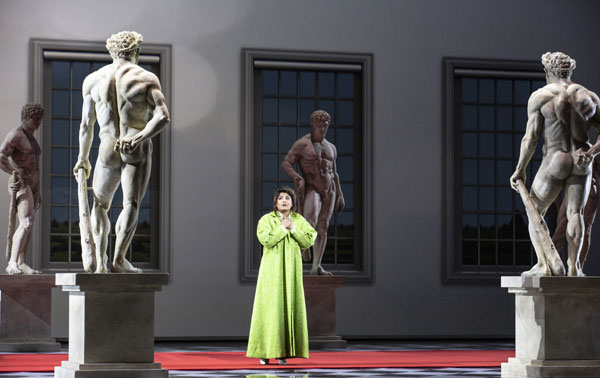
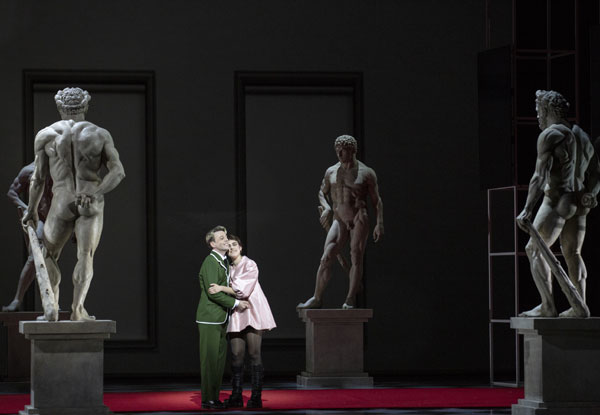
Iole, the object of desire, looked dwarfed, indistinct between the
giant Hercules statues that decorate scene after scene, all naked.
She wore a stiff baby doll and combat boots, devoid of sex appeal,
but Jones gave her a provocative moment, placing the seduction
scene around a statue of Hercules sitting with legs spread in full
-frontal nakedness. It’s a comically brilliant idea and I regretted
that the director quickly dropped allusions to sex and sexual
danger.
The French press was divided. Very few risked comparisons with
Cavalli’s Ercole amante. While some papers wrote about the fine
musical qualities of Bembo’s score, others pointed to its flaws,
especially the slog of excessive recitatives. Several felt the
production did not do Bembo a favor. The most critical voice,
Forum Opera, titled its review, “The mountain gives birth to a
mouse.” Regret about the Bastille Opera was unanimous. (Small
-scale productions have already been attempted a couple of times
since the first discovery of the score: a concert version in Stuttgart
and a chamber opera performance in San Francisco.) A different
musical concept (how about a few cuts?) that supports intimacy
and vocal finesse might do wonders for Ercole. A more dramatic
focus might even bring out an interpretations that could justify
the hype about Bembo’s contemporary relevance.
Photos: Bernd Uhlig
|