|
I wonder about the trees.
Why do we wish to hear
Forever the noise of these
More than another noise
So close to our dwelling place?
Till we lose all measure of pace,
And fixity in our joys.
They are that that talks of going
But never gets away;
And that talks no less for knowing,
As it grows wiser and older,
That now it means to stay.
My feet tug at the floor
And my head sways to my shoulder
Sometimes when I watch trees sway,
From the window or the door.
I shall make the reckless choice
Some day when they are in voice
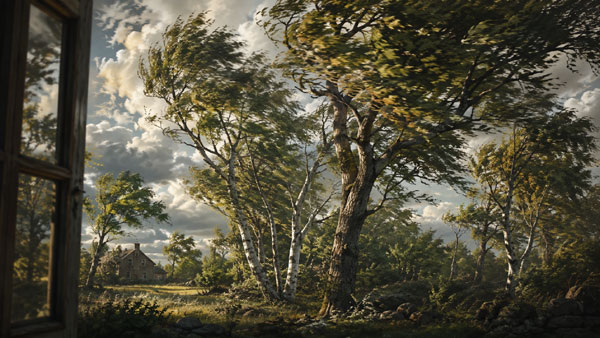
And tossing so as to scare
The white clouds over them on.
I shall have less to say,
But I shall be gone.
Unlike “Mending Wall or “The Road Not Taken,” Frost’s “The Sound of
Trees” is probably not as familiar to most readers. Those poems
include lines that have gone into our language and become aphorisms.
Even those who haven’t read Frost often say: “I took the road less
traveled by” or “Good fences make good neighbors.”
“The Sound of Trees” has a pair of lines that I find equally memorable.
Describing the sound of trees swaying in the wind, the speaker
observes:
They are that that talks of going
But never gets away
These lines let us know our poet is using the sound of trees to suggest a
human conflict. Many of us fantasize about making big changes in our
lives, but when it comes down to deciding to go, elect to “stay” in place.
Trees cannot budge from their place on the earth, and we find it
difficult to abandon the mental, emotional, and historical terrain we’re
ensconced in.
Perhaps thinking of this poem, Frost acknowledges that “All metaphor
breaks down somewhere”:
“That is the beauty of it. It is touch and go with the metaphor, and until
you have lived with it long enough you don’t know when it is going.
You don’t know how much you can get out of it and when it will cease
to yield. It is a very living thing.”
The fun in Frost’s tree metaphor is that we are well aware that it breaks
down. Like trees, we are sometimes unable to move from the many
habitual “ruts” we find ourselves in. Like Frost’s imagined trees that
seem to talk as they sway, we often talk to ourselves about the
possibility of making big changes in our lives.
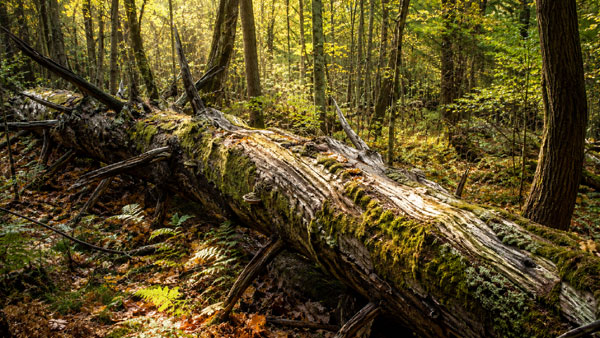
But trees are all talk. They only move when forced to do so by wind,
rain, or lightning. Could they enact their desire to get “away,” they’d
come crashing down to earth and die.
An imagined personification, they work as metaphor only because
they speak to our frustration at not being able to change our lives.
Unlike those rooted entities, we are capable of heeding Rainer Maria
Rilke’s advice when, in “Archaic Torso of Apollo,” he orders us to change our lives. We can choose to move away from our current state
of being, and the new identities we create can be salutary.
Frost, however, makes it clear that it’s more likely that changing one’s
life, especially later in life, is fraught with danger. The question he
poses via his babbling trees is why do millions of us keep listening to
insistent inner voices that compel us to toy with the possibility of
transforming ourselves into someone else? Aren’t such voices—“So
close to our dwelling place”—metaphorical lumberjacks bent on
toppling our identity?
Since the lives we’re leading offer us many “joys,” why this continual
urge to upend ourselves? Shouldn’t we take a tip from the “wiser and
older” trees who, although they talk about “going away,” mean “to stay”
safely at home in their forest, rather than becoming corpses on a truck
off to build condos in LA? Play, Robert, play!
And yet, the trees continue to sway in the wind, wishing the impossible
for themselves and the improbable for us:
Trees prevaricate incessantly. They have no other choice. But the
speaker imagines that sometime in the future, when the trees are “in
voice,” he will give in and make what he knows to be “the reckless
choice”:
I love that our poet imagines that in “tossing” his former life away he
will ‘“scare” the “white clouds” over the trees to move on as well.
Clouds can remain in the same place for a long time, then suddenly
scud away. A la Hamlet to Polonius, they are shapeshifters that can
quickly change their appearance, now looking “like a weasel,” seconds
later “very like a whale.” Easy for clouds to move away. (Notice that
before they were scared into “going” by our speaker changing his
identity they were hovering in place over the trees.)
Our speaker knows that were he to become “reckless” and toss his
“wiser and older” self away, like an uprooted tree, he would be
destroyed. So how are we to take the final lines of the poem?
We should keep in mind that everything in this poem is merely “talk.” Our speaker is imagining that he will “make the reckless choice.” He
has not actually made it. “I shall have less to say” would free him from
the mental turmoil caused by the babbling trees. An easy way to
extricate himself from actually choosing is to imagine he will “some
day” decide to change his life. In reality, he is merely kicking “choice”
down the road towards the future. Like the trees, his prevarication is
continual.
For Frost, poetry is all about creating “a momentary stay against
confusion.” Poems offer mental sanity, perceptual clarity, but only
while we read them. Outside the poem, the world remains a confusing
place where the clarity we experience in poetry becomes cloudy, and
we find ourselves acting recklessly.
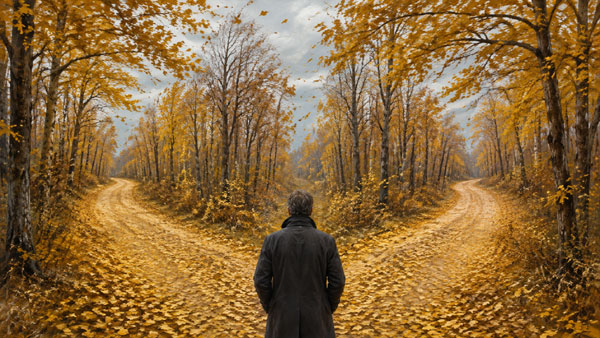
In his most famous poem about choice— “The Road Not Taken”— the
speaker absolutely knows in the present that there was no difference at
all between two roads in a wood. Choosing between them could only be
decided by a flip of a coin. But he also knows that memory deteriorates
over time; that his clarity is momentary. “Ages and ages hence,” he will
claim that he “took the road less traveled by / And that has made all
the difference.”
Something similar is going on with “The Sound of Trees.” The speaker
is not dissatisfied with his life. He knows that if he gives in to the urge
to change it, like a fallen tree, he may uproot himself and “lose all
measure of pace, / And fixity” in his “joys.” That’s his “momentary stay
against confusion.” But he also knows that the urge to change is so
powerful that he may eventually give in, even though he may end up
destroying himself.
I think that Frost is acknowledging that our urge for a fresh start is as
dangerous as it is attractive; that we should think twice before
renouncing who we are to pursue what Geoffrey Chaucer called
“newfanglenesse.”
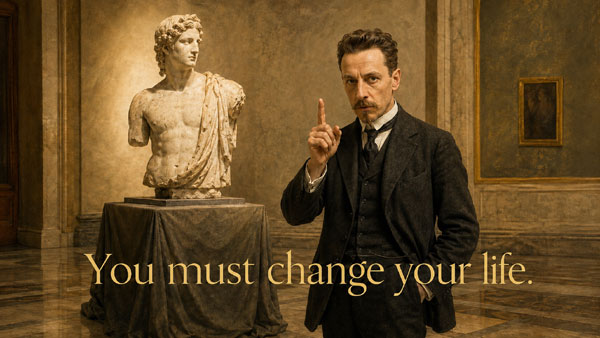
“But I shall be gone” may mean I’ll follow Rainer Maria Rilke’s advice
and transform myself into a better, more vibrant person. I think it
more likely that it means I will have erased the person I created,
nurtured, and improved over the years, while savoring its many joys
and sorrows. For me, the poem ends with a keen sense of loss that
would follow abandonment of one’s former self, were that to happen.
|