|
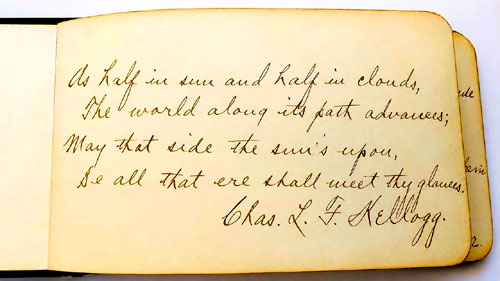
As half in sun and half in clouds,
The world along its path advances;
May that side the sun’s upon,
Be all that ere shall meet thy glances.
Chas. L.G Kellogg
The journey (as far as I know):
Seattle to NYC, 2,856 miles.
NYC to San Francisco, 2,910 miles.
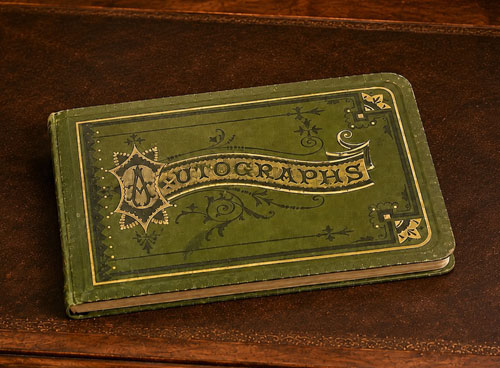
I am often asked what my favorite item is in my Gertrude Stein and Alice
B. Toklas collection. It is unquestionably a small green leather, gold
edged autograph book with slightly rubbed embossed gold lettering on its
cover from the late nineteenth century.
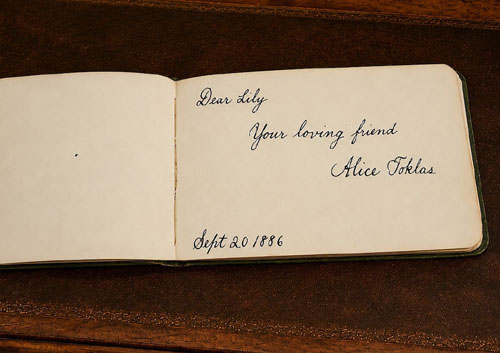
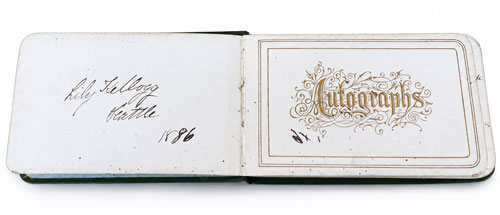
What makes it so unique is that on page 17 there is a boldly written
message to the owner of the book, Lily Kellogg of Seattle, WA, by a nine
-year-old Alice Toklas. (An uncle of Lily’s wrote the rhyme pictured
above.)
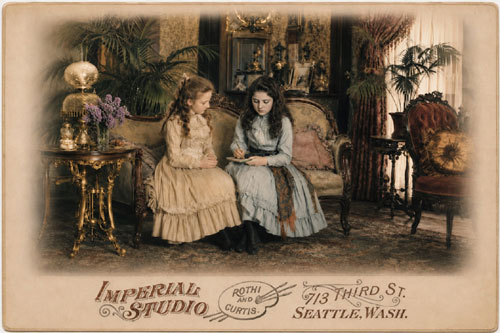
The event is recreated in a Victorian parlor in an AI generated
photograph below.
It is said that collectors, particularly those who collect items pertaining to
well-known people, collect as a way of feeling closer to that person, more
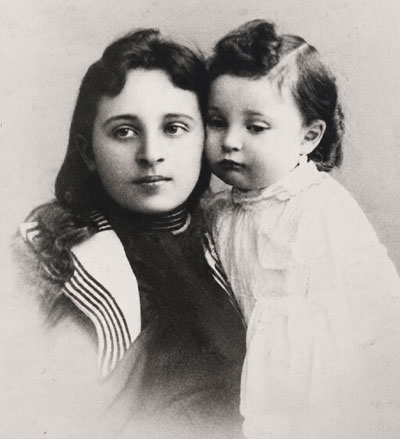
connected with their life and what they’d accomplished. Alice pictured
below with her brother Clarence about a year after she signed the
autograph book.
It is very rare, however, that one finds anything pertaining to an
individual when he or she was a child, other than possibly a photograph.
That is one reason this item is so special. To me there is another reason
this autograph book, which I purchased in the summer of 2001, has
attained an almost sacred relic status. An autograph book is in itself a
relic of the past. I received one in the late 1950s as a gift from one of my
aunts in Europe. It was lost long ago, and I can’t recall who might have
signed it. It was not until my 1967 high school yearbook, that autograph
-book type messages were scrawled on pages in the front and back of the
yearbook. I would never hear from most of those people again and their
catchy phrases and wishes for the future were soon forgotten. In thinking
about autographs a term came to mind which I haven’t thought about in
decades – the “slam book.” I’ll leave an internet search for “slam book”
to the curious, but for the not too curious, it can be viewed as an early
form of social media trolling. (Design writer Ralph Caplan said, “Nothing
is more to the point than a good digression.” Got it.)
Back to the small green leather, gold edged autograph book with the
slightly rubbed gold lettering and Alice B. Toklas.
2002 was the anniversary of Alice’s 125th birthday and in 2001, I began
thinking about ways to commemorate it. In my frequent browsing of
AbeBooks.com, a treasure trove of booksellers around the world, I often
request listings with the highest price first. I’m curious about what
Gertrude and Alice items are out there as well as if some of the things in
my collection have appreciated. (Digression: currently the most
expensive Toklas item is the 1954 first American edition of her cookbook
for…ta- dah… $45,000.00! Why? Because with the cookbook comes a
piece of paper with the legendary hashish fudge recipe on it handwritten
by Alice. That price is six times more than a copy of Alice’s second
cookbook
Aromas and Flavors Past and Present
from 1958
inscribed by Alice to Eleanor Roosevelt. Alice abhorred this book, but
that’s for another time. End of digression.)
In a July or August 2001 AbeBooks search, I found the Lily Kellogg (no
relation to the cereal Kelloggs) autograph book being sold by Locus Solus
Rare Books in lower Manhattan. I
had
to have it for Alice’s upcoming
sesquicentennial fête. The book had belonged to a childhood friend of
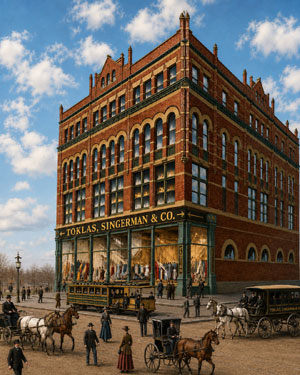
Alice’s; Alice had met Lily in Seattle when the Toklases moved there for
about five years from San Francisco. Alice’s father had opened a
department store in Seattle, while Lily’s father had gained prominence by
founding the city’s first drugstore.
What better birthday gift than to reunite a Seattle autograph book (with
Alice’s signature) via NYC to San Francisco, Alice’s birthplace. What a
journey!
As I was not sure about the exact date on which I bought Lily’s book, last
month, while I was outlining this article, I emailed James Goldwasser
whose Locus Solus Rare Books is now in Los Angeles. He sent me a copy
of the invoice but was not certain when the autograph book had shipped.
I recall mailing him a check sometime in mid-August. The autograph
book was sent between late August and early September 2001 via UPS
from their Prince Street location in SOHO.
The package arrived in San Francisco about a week after September 11th.
When it arrived, I remember checking to see when it had been sent and
noticed it had been about five days before 9/11. I have come to believe
that had it been sent two or three days later or not until my check arrived
on 9/10, it may have been caught up in the horrific chaos and tragedies
in the area near the Twin Towers and been lost. Prince Street was a mile
and a half North of Ground Zero and was within the exclusion zone. As a
result, according to James, he was unable to go to work for two weeks.
James was still at home the morning of 9/11 and recounted it to me:
“I was at home. It was early morning and I was getting ready to go
vote and then head into work. I had meant to stop by Century 21 to
buy socks on the way – it was across the street from the World Trade
Center. We lived in Cobble Hill Brooklyn and could see the towers
from our kitchen window—we heard the impact of the crashes and
watched as dust and a confetti of office paper fell all over the
neighborhood. The day is fixed in my memory in almost every detail.”
An average early morning whose date would never be average again for
all of the world.
Of the thirty wishes written to Lily, many are just “Your friend” and a
signature in pristine 19th century, carefully practiced penmanship.
Then there are the ones that are more creative with various ditties, some
of them didactic:
When rocks and walls divide us
And you no more I see.
Remember it was Bessie
Who wrote these lines to thee.
Bessie Hill
Our greatest glory is not in ever falling, but in rising every time we fall.
Carrie H. Shumway
Poor ink.
Poor pen.
Poor writing.
Amen.
R.A.
Though the world be in love
With bright eyes and fair hair,
‘Tis only good children
The angels call fair.
Katherine F. Cheasty
Lillie is your name
Single is your station.
Happy be the little man
Who made the alteration.” [“made?” How about “makes?”]
Emma Knapp
As your school days pass, see that in each one a good seed is planted
that shall bear (sic) rich fruit in the future.
Helen G. DeVoe
Your Album is your garden,
You have many seeds to sow.
I will sow the sweet forget-me-not
And plant my name below.
E. Brown
Dare to be honest, good, and sincere:
Care to please God, and you never need fear.
Lovingly your friend,
L.M. Newman
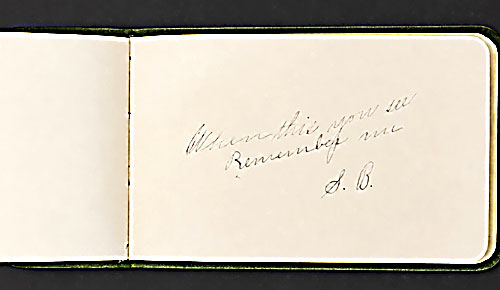
By coincidence, on page 27 there is a very faded inscription by S.B.:
“When this you see remember me,” which has several connections to
Gertrude Stein.
This is an old sentiment which has been used since the 18th century and
was often stitched on samplers when a girl was learning to sew.
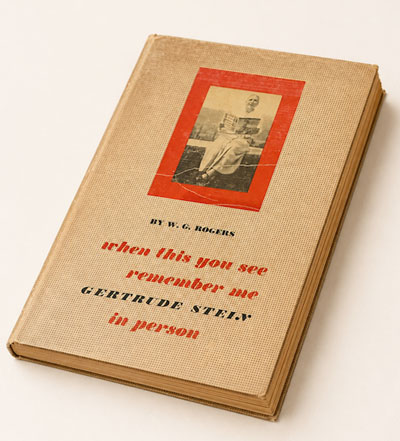
It is the title of the first biography about Gertrude Stein following her
death,
When This You See, Remember Me: Gertrude Stein in
Person
by W. G. Rogers published in 1948, two years after she died.
Rogers had known Gertrude and Alice since he had been a young World
War I soldier and became a lifelong friend.
Gertrude also used it in one of the hymns in the libretto of her 1934
opera, “Four Saints in Three Acts,” with music by Virgil Thomson:
When this you see remember me.
They have to be.
The have to be.
They have to be to see.
To see to say.
Laterally they may.”
In 1970 in conjunction with public television station WNET, one of the
most comprehensive documentaries, “Gertrude Stein: When This You
See, Remember Me” was directed by Perry Miller Adado. Part of its
historic interest is that many of Gertrude’s contemporaries were still
alive when it was made and are interviewed in the film which is available
on YouTube. Lastly, the phrase was included in cover notes on the
Rolling Stones’ 1969 album Through the Past, Darkly (Big Hits
Vol. 2) ”as a tribute to Brian Jones one of the band’s founders.”
There is, of course, no comparison between the survival of a small
nineteenth-century autograph book and the terrible loss of life and
profound consequences of September 11, 2001. Yet the book’s journey
through New York in the days immediately before the attacks has
become inseparable, for me, from its history. That coincidence is why it
seems appropriate to tell its story now, on the twenty-fifth anniversary of
9/11.
An autograph book was created for remembering. Within the pages of
Lily’s book, friends and family offered a young Victorian girl affection,
humor, encouragement, and hopeful words about the life that lay ahead
of her. Some urged her to greet the future with excitement and
anticipation; others simply asked that she remember them. None of those
people, writing in the closing years of the nineteenth century, could
possibly have imagined what the coming decades would bring—the
extraordinary achievements as well as the wars, destruction, tragedies,
and transformations that would reshape their world.
More than a century later, this particular book passed through New York
just days before an event that would itself become an indelible part of
our collective memory. This month’s Portrait about an autograph book
linked to Alice B. Toklas and 9/11 is written not because their
significance is remotely comparable, but because this fragile object,
created to carry memories from one generation into another,
unexpectedly acquired another history of remembrance during its
journey from Seattle, through New York City, to San Francisco. In that
context, one of the simplest, now faded inscriptions in that small green,
leather gold edged autograph book with slightly rubbed embossed gold
lettering on its cover takes on a relevance S.B. could never have
foreseen:
“When this you see remember me.”
Art of the Month
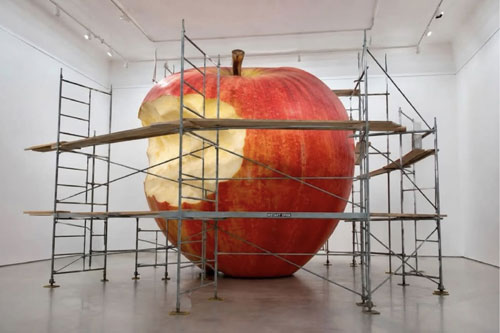
“Preserving the Impermanent,” Vito Gaarin
(Generative AI digital image, 2026)
courtesy of the artist
www.facebook.com/profile.php?id=61590137965504
Special thanks, then and now to
James Goldwasser and Locus Solus Rare Books
|