|
It
is beguiling that a
movie based on one of
the foundational
stories of Western
civilization should be
both a record-breaking
hit—soaring over
$1 billion in box
office receipts within
a month of its
release—and the
center of spirited
debate, both cinematic
and intellectual.
Christopher Nolan’s film of The Odyssey opened
in July to mostly
laudatory reviews,
despite right-wing
pundits carping about
Nolan’s casting
choices (i.e. Black
actress Lupita
N’yongo as Helen
of Troy and transgender
actor Elliot Page as
the warrior
Sinon). Far more
serious criticism came
from Odyssey translator
Emily Wilson in the London Review of Books. Wilson—whose
bestselling translation
and its opening line,
“Tell me about a
complicated man,”
Nolan cited as one of
his
inspirations—wrote
a long essay about
Nolan’s film that
is a masterpiece of
damning with the very
faintest praise.
The tone of
Wilson’s article
can be taken from its
title, “An
Uncomplicated
Man.”
Making it clear that
she’s not a fan
of Nolan’s films
in general, Wilson
wrote that his Odyssey is
“a
family-friendly
audiovisual spectacle,
like an elaborate
Fourth of July
fireworks
display—and with
about the same level of
narrative and emotional
depth.” Of
Nolan’s
screenplay, she said,
“I would be
ashamed to have written
any of it,” and
proceeded to
demonstrate how Nolan
flattened out the
character of Odysseus
and elided or diluted
both the substance and
the meaning of his
adventures.
Wilson has come in for
some harsh criticism
herself, including from
Joyce Carol
Oates.
“(H)er tone of
dismissal and haughty
superiority struck a
sour note,” Oates
wrote on X.
“(S)ince all
translations are,
presumably, subjective
& not equivalent to
the original text, one
would expect a
translator…to be
just a wee bit more
thoughtful &
respectful of others
who are acting in good
faith.”
Other writers,
however—writing
either in response or
parallel to
Wilson—agreed
with her criticisms of
Nolan’s changes
to the text, especially
his elimination of the
gods (Richard Brody in The New Yorker) and the sex (Maureen Dowd in The
New York Times).
All of this, of course, begs the question of what Miles Moore
thinks of Nolan’s Odyssey. I agreed with most of Wilson’s
criticisms, yet I liked the movie better than she did, and I did not
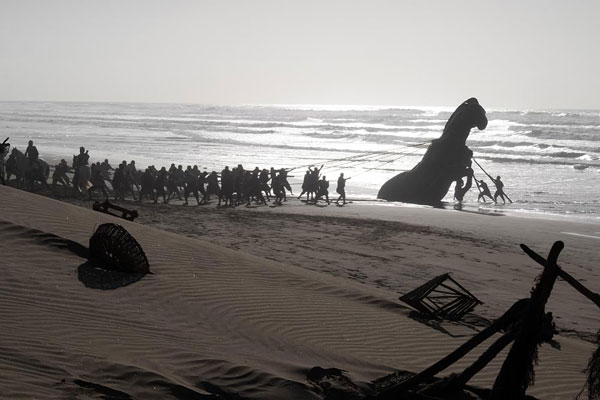
find it trivial. It is spectacularly shot and often engrossing,
but—as often happens—the original text takes a back seat to the
exigencies of running time and the filmmaker’s personal
concerns. The friend with whom I saw The Odyssey—an
aficionado of Homer and Greek antiquity—gave the movie a B,
but also said it would take a 24-part miniseries to even come
close to doing justice to Homer. I think my friend was being fair,
but given Nolan’s sheer filmmaking panache, I might give his film
a B+ or even an A-.
James Joyce famously called Odysseus “the only complete man in
literature,” so it is disappointing to see the narrowly construed
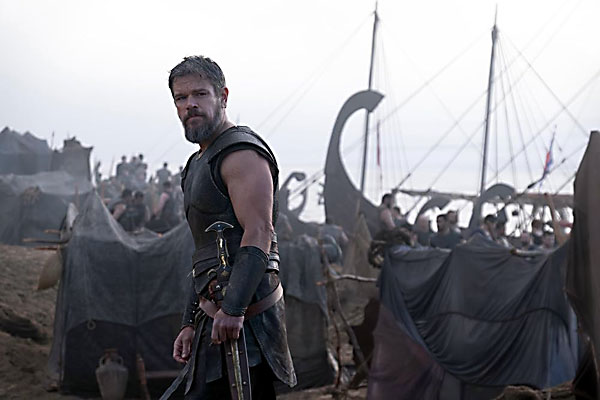
character as written by Nolan and played by Matt Damon. For
most of the film, Damon’s Odysseus is a grimly determined
military commander, intent only on getting home and getting his
men home. We have seen this character in countless war movies,
although Damon plays him with strength and conviction. Damon
is capable of playing the multilayered trickster, pirate, storyteller,
amorist and hero who is Odysseus, but that is not what Nolan
gave him to play.
Nolan’s vision of The Odyssey is one in which the role of the
Olympian gods is veiled. This seems perverse in an
interpretation of a story that begins with Athena interceding with
Zeus on Odysseus’ behalf. (Athena, played by Zendaya, is a
fleeting presence in Nolan’s movie.) Nolan either didn’t think
modern audiences would relate to the gods of antiquity or felt
those gods would hinder the presentation of his thesis of a
civilization in calamitous decline. Odysseus and other characters
speak constantly of “Zeus’ law,” a way of referring to xenia, the
sacred laws governing the extension and acceptance of
hospitality, but Zeus himself is not in evidence.
Some of the deity-related episodes in Nolan’s Odyssey are
presented more or less as they are in the book, such as the doom
Odysseus’ men bring on themselves by eating the sacred cattle of
Helios. But others are changed or denatured. Nolan makes
effective horror sequences out of Odysseus’ encounters with
Polyphemus (Bill Irwin) and Circe (Samantha Morton), but the
characters are redrawn. Polyphemus is simply a giant ogre living
in a cave. There are no other Cyclopes, so there is no reason for
Nolan to present Odysseus’ trick of telling Polyphemus his name
is No Man; there is no one to hear Polyphemus cry out, “No Man
is hurting me!” Wilson makes a particular point of this.
Similarly, Circe is a vengeful sorceress in Nolan’s Odyssey, not the
seductive goddess in Homer who entices Odysseus to stay with
her for a year. Nevertheless, the sheer ferocity of Morton’s
performance makes it one of the film’s most memorable. Charlize
Theron fares less well as Calypso, the goddess-nymph who keeps
Odysseus in thrall for seven years. Nolan’s script conflates
Odysseus’ sojourn with Calypso with the tale of the lotus-eaters,
and more than one critic has noted that Nolan’s Calypso is more
like Odysseus’ therapist than his lover-captor. The absence of
Hermes, who plays a major role in both the Circe and Calypso
chapters, is also disappointing.
Despite this, Nolan’s Odyssey still gives the gods more of a
presence than The Return, Uberto Pasolini’s bleak 2024 film
starring Ralph Fiennes as Odysseus. (Wilson prefers The Return to Nolan’s film, saying that it “invited us to wonder what remains
of The Odyssey and its hero when stripped down to the sinews
and the hungry heart.” I understand her point, but I found The
Return dispiriting.)
These are only a few of the changes Nolan made to Homer’s text.
Scholars and fans of that text have a reason to be irked. Yet what
Nolan actually puts on screen is impressive, the Calypso episode
notwithstanding. The movie sweeps us along throughout its
running time; the music and sound design alone, courtesy of
Nolan regular Ludwig Goransson, overwhelm us with their
headlong power. The same can be said of the contributions of
cinematographer Hoyte van Hoytema, editor Jennifer Lame, and
production designer Ruth de Jong. (See the movie in IMAX if
you possibly can.)
In interviews, Nolan has said that he believes his vision of The
Odyssey is consonant with that of its original readers. “Homer’s
writing about an era before his, he’s writing about an era
hundreds of years before,” he told podcaster Zhong Shu. “His
audience viewed it as being more advanced than theirs. They had
this idea of the greatness of this past civilization. And I became
interested in that collapse, what they call the catastrophe, the
Bronze Age collapse.”
Nolan’s interview brings into focus his feelings about The Odyssey and its ultimate significance. The film is imbued with the
melancholy of a dying civilization, with its denizens fully aware of
its passing. Nolan’s version of the story can be seen in the same
light as Oppenheimer, with both Odysseus and Robert
Oppenheimer as the reluctant destroyers of worlds. Just as
Oppenheimer changed the world for the worse with the atomic
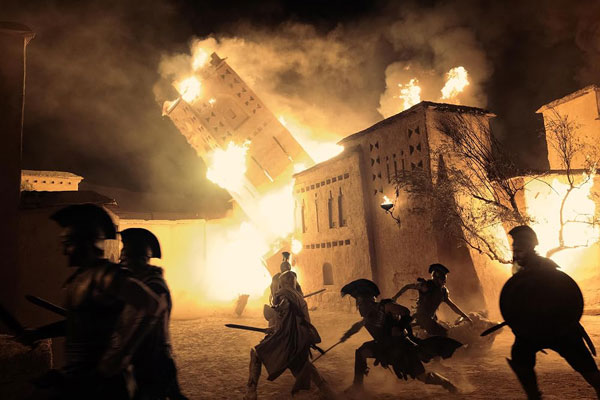
bomb, so did Odysseus with the Trojan Horse. The incendiary
horror scenes depicting the fall of Troy speak very much to this
thesis. So do the scenes in Ithaca, both before and after Odysseus’
return, depicting the principle of “Zeus’ law” in full
disintegration. The suitors of Penelope create chaos, and in turn
reap chaos when Odysseus returns. The result, Nolan
demonstrates, does not portend peace or happiness.
The acting in the Ithaca scenes is some of the film’s best. Damon,
returning to his kingdom as a beggar who must prove his identity
and his mettle, comes into his own in his final scenes, and the
quartet of main actors surrounding him is impressive. John
Leguizamo is deeply moving as loyal slave Eumaeus, Robert
Pattinson is sublimely hissable as Antinous, the most despicable
of Penelope’s suitors. Anne Hathaway makes a luminous
Penelope, and Tom Holland a sympathetic Telemachus.
(Holland has been accused of being too callow, but isn’t
Telemachus supposed to be callow?)
It is hardly surprising that Emily Wilson—a renowned classical
scholar who has lived in the world of Homer throughout her
career, and who is preparing a second translation of The Odyssey as I write this—would hold any film adaptation of The Odyssey to
a standard any three-hour movie would be unlikely to meet.
Barring a miniseries, and perhaps not even then, no movie
adaptation will ever meet such a standard. As a retelling of
Homer, Nolan’s film leaves a great deal out, but considered
strictly as a movie, it works. It’s not my favorite Nolan film—I
rate Inception and Oppenheimer above it—but I enjoyed it and I
think most people will.
Meanwhile, Wilson’s final words on Nolan’s Odyssey are astute
and deeply hopeful. “(T)his epic is bringing audiences back to
cinemas,” she writes. “In what we are told is a time of declining
literacy and the ‘death of the humanities,’ translations of The
Odyssey, including mine, are flying off the shelves. Some of those
who buy the book or show up in cinemas to watch Tom Holland
may go on to study ancient Greek. Perhaps the film will persuade
a few college administrators not to cut their literature, language
and history departments. Nolan…is doing his best to get the
general public reading again, and I am grateful.”
|