|
JY.
In your childhood or surrounding environment, was there a particular person, event, or memory that became an important catalyst for your interest in art? How did that early fascination differ from—or contribute to—the identity of your Pop Surrealist work today?
SA.
My passion for art began with my love of drawing
from my imagination as a child. I remember that even
before I started kindergarten, I would draw on anything
within reach—whether notebooks, sheets of paper,
newspapers, or any blank surface I could find. Whenever
I had a pencil or colored pencils, I would immediately
start drawing. My mother often bought me coloring
books, and I could sit and color for an entire day without
ever getting bored.
My mother was the first person who taught me to draw.
The earliest image I remember drawing was a pig from
behind, which she taught me how to make. It is only a
small fragment of childhood memory, but looking back, I
feel that it was an important beginning to my
relationship with art.
Not long afterward, my mother became a single parent.
Our lives became more complicated, and there was more
change and exhaustion. At that age, I was too young to
understand what was happening, so I interpreted my
mother’s silence and emotional distance as meaning that
I was somehow a burden. As I grew older, however, I
came to understand that she was simply trying to cope
with life and her own emotions on her own.
Art gradually became something that remained with me
during a period when relationships and communication
with the people around me were not always easy.
Drawing gave me a sense of concentration and allowed
me to remain absorbed in one thing for long periods of
time. At the same time, art was accessible and did not
require much money. The colored pencils my mother
could afford became not only tools for drawing, but
materials for creating entire little worlds: paper dolls,
dollhouses made from cardboard, cars made from boxes.
I therefore never saw art as simply drawing. It was a way
of building a small world of my own.
As I grew older, drawing came to mean much more than
enjoyment. It became a place where I could retreat from
the outside world—from social life at school and from
certain feelings within my family. Gradually, I found
conversations with other people more difficult. I was
often afraid that I might make others uncomfortable, so I
returned to drawing. Within a drawing, I did not have to
explain myself to anyone. I could simply create according
to my imagination.
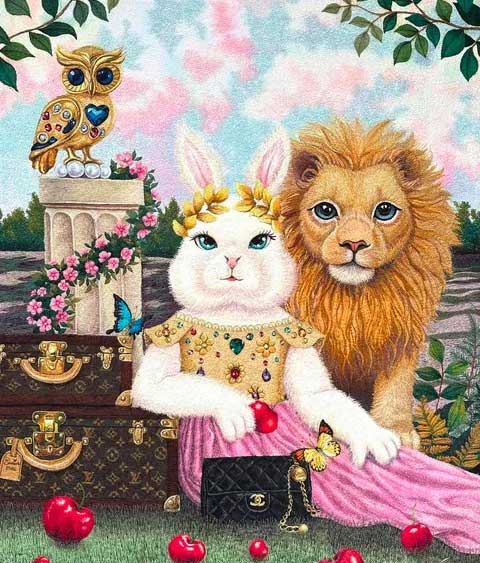
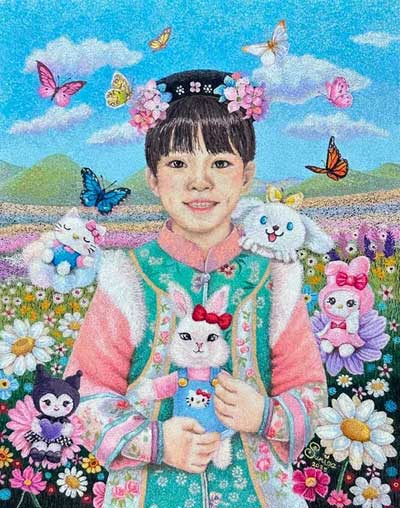
I believe these experiences have played an important
role in shaping the identity of my Pop Surrealist work
today, particularly my interest in creating worlds that
exist somewhere between reality and dreams—worlds
filled with beauty, wonder, and emotions that are
sometimes difficult to put into words.
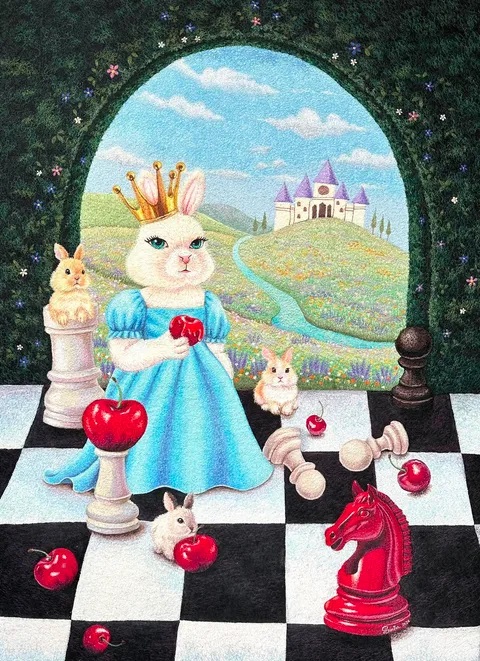
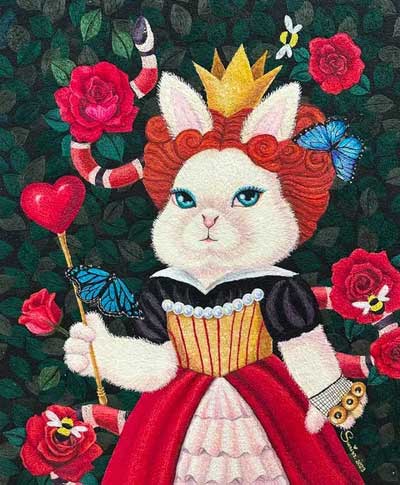
The rabbit that appears in my work also originated from
a childhood memory. It has become a character that
connects my past with my present, taking me back to the
imaginative world that once served as a safe space for
me.
For me, art is therefore not simply about creating
beautiful images. It is about creating a small inner space
where I can return to myself. It is a space of dreams,
love, goodness, and the healing of feelings that may not
yet be possible to express through words.
JY.
During your university art education, were there
particular academic environments, courses, or professors
whose guidance played an important role in shaping
your way of thinking and helping you move from being a
student toward discovering Embroidery Art as a
technique that eventually became your signature? Were
there also artists you worked with or achievements that
influenced this development?
SA.
When I was studying art, I did not yet clearly
understand what it meant to “find my artistic identity.” I
only knew that I had to complete my work by the
deadline, present it, and listen to critiques from my
professors. I was always trying to discover what made my
work distinctive, but I could not find a clear answer.
Sometimes I even wondered if perhaps I was simply a
slow learner.
The major turning point came during my fourth year,
when I was studying Painting. I was short one elective
credit, so I needed to find another course. At the time, I
could choose from stone carving, wood carving, fashion
design, and Fabric Art. I did not feel particularly drawn
to or confident in any of them. But on that particular day,
I happened to meet the professor teaching Fabric Art,
and she was willing to sign me into an older course code.
That was how I ended up taking her class.
That professor was Associate Professor Pornprom
Chaowang, who later became my advisor at both the
undergraduate and master’s levels.
Before taking her class, I always felt somewhat
intimidated by her because she was quiet, with a rather
reserved expression and tone of voice. But through the
Fabric Art course, I discovered a side of her that I had
never experienced before. She was someone who could
recognize the potential in her students and knew how to
encourage them precisely where they lacked confidence.
She once told me, “Sunisa has a good sense of color and
fabric patterns.”
It was a simple sentence, but it meant a great deal to me.
At that time, I had very little confidence in presenting my
own work. Having a professor recognize something in
my work made me begin to believe that perhaps I had an
ability I had not yet discovered in myself.
From that point, making art became less about forcing
myself to produce something and more about enjoying
the process of experimentation. My work became more
interesting and began to feel more like my own. My
professor encouraged me to try using fabric techniques
instead of painting, and that became an important
starting point in the discovery of the technique that
would eventually develop into my Embroidery Art.
While studying Painting, I created works based on
amusement parks from my imagination. They were
colorful and beautiful, with interesting spatial
compositions. Yet when I look back at them now, I
realize that they carried a sense of loneliness and
eeriness. I tried to introduce characters into the scenes,
but I could never find the right place for them. I was
afraid they would make the images feel cluttered or
interfere with the space, so I chose to leave the
amusement parks empty.
At the time, I did not understand why I could not place
other characters within those images. As I grew older, I
began to understand myself more clearly. Perhaps that
sense of solitude, and the presence of a strong inner
world, had already been finding its way into my work
without my realizing it.
My professor’s suggestion to use fabric instead of paint
was therefore not simply a change of material or
technique. It opened the door to a way of expressing my
feelings and imagination that felt more natural to me.
The patterns, colors, and textures of fabric brought a
different kind of energy to the amusement parks in my
imagination. They could feel playful and alive in their
own way, even without any characters appearing in
them.
Beyond Professor Pornprom, another person has played
a very important role in my journey toward becoming a
professional artist: Kulachet Khaochaiyamaha. We were
in the same cohort in the master’s program in Applied
Arts, and we began working on art together during our
graduate studies.
Before that, I had never really understood that being an
artist could be a profession. I loved drawing and creating
artwork, but I had never imagined that the things we
made could be sold or could become a career capable of
supporting us.
Kulachet opened my eyes to this possibility. He advised
and taught me about concepts, composition, creating
beauty in a work, and the importance of intention. He
helped me understand that being an artist is not simply
about having the ability to draw. It also means taking
responsibility for your work, continuously developing
yourself, and recognizing the value of what you create.
Working together gradually changed me from someone
who drew simply because I loved it into someone who
was committed to making art seriously. We exchanged
ideas, critiqued one another’s work, and learned from
each other continuously, from our master’s studies
through to the present.
Looking back, I feel that discovering my artistic identity
was not the result of one person alone. It came through
education, through professors who could see potential in
me, and through people close to me who helped me
believe in what I was doing.
Professor Pornprom opened the door for me to discover
my own artistic language, while Kulachet helped me see
that this language could genuinely become a profession.
From that initial encounter with fabric, my work
gradually evolved into creating images through thread
and hand embroidery, which eventually became my
distinctive signature.
For me, discovering one’s identity is not about finding an
answer immediately. It is about gradually growing
through making, experimenting, and having someone
recognize a potential within us before we are able to
recognize it ourselves.

JY
. What knowledge did you have to acquire
independently in order to break through conventional
ways of thinking and demonstrate that “thread” can
possess the same storytelling power as a brushstroke?
SA.
After completing my master’s degree, I exhibited my
thesis series, Poetry of the Seasons, at Cassia Gallery,
with the generous support of Ambassador Worapoj and
Khun Patcharin Sanitwong Na Ayudhya, the gallery’s
owner. The response to the exhibition was very positive,
and it was an important moment for me because I felt
that my efforts as an artist were finally being seen.
I spent two years working on my thesis, which meant
that I ultimately took five years to complete my master’s
degree. During that period, some family members and
friends did not understand and assumed that I was
taking so long because I was spending my time playing or
traveling. But for me, making art is a process that
requires time. It cannot simply be rushed because there
is a deadline.
So I chose to answer those questions through the quality
of my work rather than through explanations. I believe
the work itself is the strongest evidence of our
commitment and effort.
That body of work taught me that choosing fabric as the
primary material did not make the process any easier
than painting. In fact, it was the opposite. Cutting and
assembling small pieces of fabric, layering them to create
depth, light, shadow, and tonal values, was extremely
time-consuming. Dyeing the fabric to achieve the precise
colors and tonalities I wanted also required repeated
experimentation.
With painting, we can simply mix white or black into a
color to adjust its tonal value. With fabric, however, we
have to consider the material itself, dye it, and
experiment repeatedly. There were times when I became
exhausted and wanted to return to painting.
I did return to painting, and I found the process relaxing
because I could mix colors much more quickly. But when
I looked at the resulting work, I realized that I still could
not find the distinctive quality or identity I was searching
for in painting.
That was when I asked myself: Why do I actually want to
stop working with fabric?
I realized that I was not tired of creating with fabric. I
was tired of the particular process—the cutting and
assembling of tiny pieces and the many stages involved
in dyeing. I also had problems with fabric dust, which
affected me physically.
Then one day, I happened to look at a drawer filled with
threads in many different colors, arranged in beautiful
gradations. The threads reminded me of the tubes of
paint I had once used. Suddenly, I thought: “What if I
used thread instead of paint?”
Until then, I had used thread mainly to create patterns
and decorate the atmosphere of an image. But this time,
I began using thread as a direct substitute for paint. I
started arranging and layering threads in different
shades to create tonal values, light, and shadow.
That discovery made me realize that what I wanted to
return to was not necessarily oil painting itself. What I
wanted was to return to the way of thinking like a
painter—to use color to construct an image and
communicate emotion. The only difference was that
instead of mixing colors on a palette, I would work with
colors already contained within the threads.
From that moment, I began developing my hand
-embroidery technique seriously. I experimented with
selecting shades, arranging individual threads, and
layering them to create depth within the image.
Gradually, this became an artistic language of my own.
The process did not necessarily become faster. In some
ways, it became even more time-consuming because the
threads are so fine and must be stitched one strand and
one color at a time. Yet I felt that this process responded
much more closely to what I wanted to express.
For me, thread is therefore not simply a material
associated with handicraft. It is a material capable of
creating images, building atmosphere, and conveying
emotion just as paint or brushstrokes can.
Every stitch is a gradual weaving together of thoughts,
dreams, and stories through a process that requires time,
patience, and dedication.
I do not think breaking through conventional thinking
means that handicraft has to be transformed into Fine
Art in order to prove that it has value. Rather, it is about
showing that every material has artistic potential if an
artist can discover how to use it to communicate their
own thoughts and feelings clearly.
For me, thread is the material that allows me to translate
the world of dreams and memories into images in the
most natural way.
JY.
During your early journey of learning and
developing your practice, you spent considerable time
experimenting through trial and error, including your
early Collage works. What important lesson—or
significant failure—do you consider a key turning point
in sharpening your embroidery technique and giving it
the depth it possesses today?
SA.
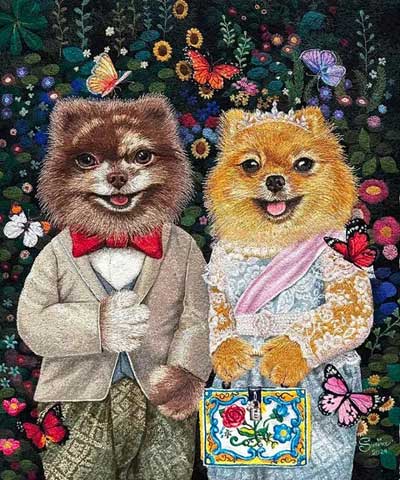
When I first began working with fabric, I started
with Collage, cutting and freely combining fabrics with
different patterns and colors. It was a very enjoyable
period because I felt that I was no longer beginning with
colors mixed on a palette. Instead, I was starting with
“colors and patterns that already existed” and using my
imagination to transform them into images of my own.
But as I continued working, I encountered an important
limitation. The edges where the pieces of fabric were
sewn together were stiff and tended to carry similar tonal
values. This made it difficult to create a sense of
distance—to establish foreground and background or to
push and pull the spatial relationships within the image.
The work therefore remained too much on a single
plane.
That limitation encouraged me to experiment further. I
began dyeing the fabric myself so that I could control the
colors, tonal values, and degrees of intensity more
precisely. I used these variations to create depth and
negative space within the image.
At the same time, I began introducing thread to decorate
the work and create lines and patterns. During this
period, I was inspired by Quilt techniques, which allowed
me to see the possibilities of bringing individual pieces of
fabric together not simply as materials, but as part of the
structure and visual language of the image.
Gradually, I moved from fabric collage toward creating
increasingly complex surfaces, light and shadow, and
spatial relationships.
Looking back, I think the mistakes and limitations of
those early works were extremely important. If the
Collage pieces had not presented the problem of stiff
fabric edges, I might never have started experimenting
with dyeing fabric. I might not have discovered how to
create depth using the materials already available to me.
Through these experiments, the technique continued to
evolve until it reached the work I make today, where
thread replaces paint. I select and arrange threads one
color and one tonal value at a time to create light,
shadow, color, and atmosphere.
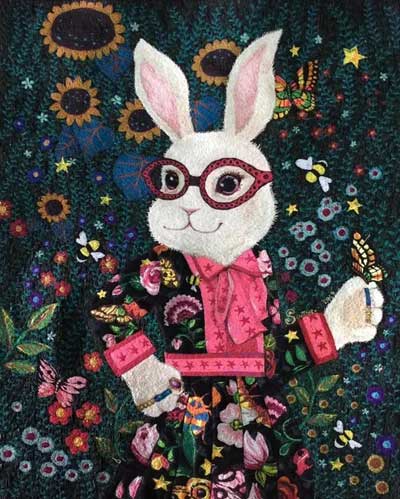
I call my approach “Embroidery Art” because, for me,
embroidery is no longer simply a craft or a way of
decorating fabric. It has become a way of “painting with
thread”—an artistic language that gradually emerged
from years of experimentation, mistakes, and
discoveries.
What I have learned is that sometimes the limitations of
a material are not obstacles to the creative process.
Instead, they can push us to ask new questions. And
those questions may ultimately lead us toward a
technique that becomes our own artistic identity.
JY.
Looking back on your experiences both within and
beyond the formal education system, what do you believe
art education today should provide for the younger
generation so that they can discover their own identities
and develop specialized artistic practices capable of
growing on an international level?
SA.
From my experience, I believe that art education
today should not be limited to teaching students how to
draw well or how to produce work according to
established principles. It should be a space where each
person is encouraged to experiment, ask questions, and
discover their own way of communicating.
Formal education is important because it provides a
foundation in skills, knowledge, composition, and ways
of thinking. But learning outside the classroom is equally
important: encountering a wide range of art, speaking
with artists, experimenting with unfamiliar materials,
and learning from our own mistakes.
Sometimes an artistic identity does not emerge simply
from following instructions. It can emerge from trying
something that no one has taught us yet—or something
that we ourselves are not even sure will succeed.
I would like the younger generation to have the
opportunity to explore their own interests seriously
without feeling that they must immediately decide
whether their work is good or bad. They should not be
afraid to change the way they work either. Changing
materials, changing techniques, or starting again does
not mean that we have failed. It can be an essential part
of developing a clearer artistic language.
At the same time, young artists should be encouraged to
understand both the creative and professional sides of an
art career: how to present their work, build a portfolio,
communicate with galleries, manage copyright, establish
pricing, and use digital media appropriately.
Growing internationally does not come from having good
artwork alone. Artists also need the ability to
communicate their identity and help audiences from
different cultural backgrounds understand what they are
trying to express.
I believe Thai art has the potential to grow
internationally if artists have the courage to develop
their own artistic language clearly, rather than creating
work simply to follow trends or meet market
expectations.
What matters is having roots in our own experiences,
and then developing those experiences into something
contemporary that can communicate with a wider
audience.
For me, good art education should help young people
discover “what they themselves have to say” and give
them the skills, confidence, and courage to communicate
it through their own work continuously.
An artistic identity does not emerge in a single day. It
gradually grows through making, experimenting, failing,
and returning to the work again—with a deeper
understanding than before.
Contact
Facebook: Sunisa Assawinrungroj
Instagram: Gie_Sunisa
WhatsApp: Gie_Sunisa
|