|
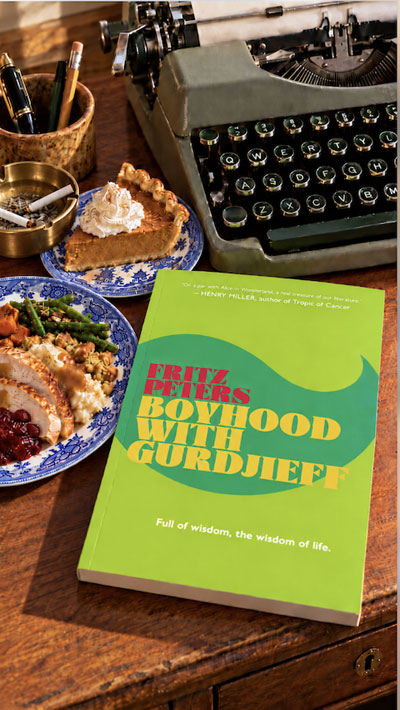
“Our
first visit to Paris to
see Gertrude [Stein] was a
memorable one…That
first visit was on
Thanksgiving Day. I have
never known such a
Thanksgiving feast in my
life…I was very
moved when I learned that
most of the traditional
American foods - including
sweet potatoes, pumpkin
pie, marshmallows,
cranberries had been
specially ordered from
America.”
—Fritz Peters in
Boyhood with Gurdjieff
(1964/2019)
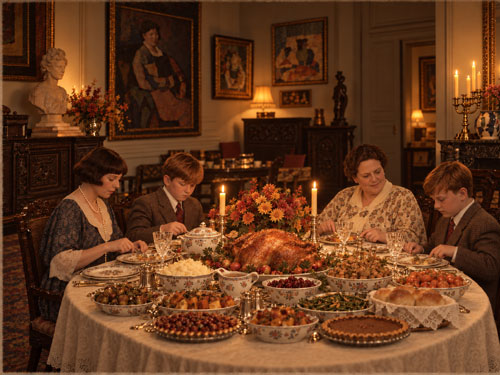
Thanksgiving 1925. Paris, 27 rue de Fleurus
Two young American
brothers, nephews of the
bohemian editor of the
avant-garde “The
Little Review”, sat
down for a traditional
Thanksgiving dinner with
Gertrude Stein and Alice
B. Toklas. One of the
boys, Fritz Peters, would
become a writer and
publish one of the early
gay novels of the late
1950s, Finistere.
He would write other
novels and a three book
memoir about the years he
and his brother, Tom,
spent at a boarding school
outside of Paris run by
the Rasputin-like,
Armenian mystic
Georges Gurdjieff.
There have been harvest fêtes for thousands of years around the globe
and many of them continue each year. From the Americas and the
Caribbean to Europe to Asia and South Asia to Africa to the Middle East
and to an island off the coast of Australia, food and thanksgiving
abound. Whether called Thanksgiving in Canada, Liberia and Norfolk
Island, Australia or Crop Over in Barbados or Chuseok in Korea or Pongal in India to name a few. The beerhall guzzling of Oktoberfest in
Germany isn’t included as that celebration originated in honor of the
marriage of Crown Prince Ludwig of Bavaria in October, 1810. In
Germany and Austria , it’s Erntedankfest, translated as “Harvest Thanks
Celebration.” And not to forget the one-of-a-kind, all-American
Thanksgiving which Gertrude and Alice lovingly recreated for Fritz and
Tom in Paris.
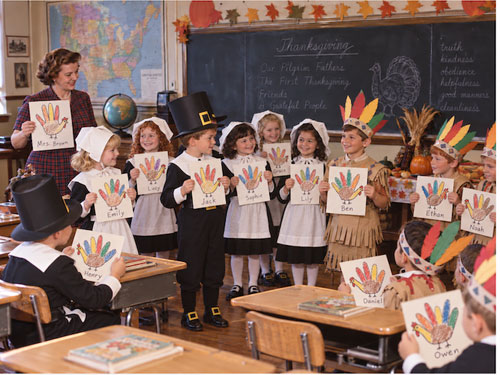
As children, some of us were in pageants (no swimsuit competition or
“How do you plan to save civilization” questions,) just large cardboard
buckles on shoes, black poster board almost stovepipe top hats for boy
pilgrims and white rimmed, almost
Handmaid’s Tale
bonnets for the
girl pilgrims. Hats and bonnets would match any black and white attire
parents had been able to pull together. (A bit like Halloween but a very
regimented dress code.)
Then there were the Native Americans whose Martha-Stewartlike
gardening and survival techniques had helped newfound landers
survive their first year in this newfound land, which belonged to people
who had found it earlier when it was newer. Thus, a gathering of real
thankfulness and neighborliness would morph into the American feast
of overeating with the gathering of family members from far and wide,
with a few interlopers who had nowhere else to go, all ready to squabble
over politics, what kind of college major is that or why are we missing
the green bean casserole this year?
There were probably some awkward moments at the first feast, but
getting Thanksgiving on the holiday calendar was plenty awkward and
chaotic with lots of governmental involvement. Go figure.
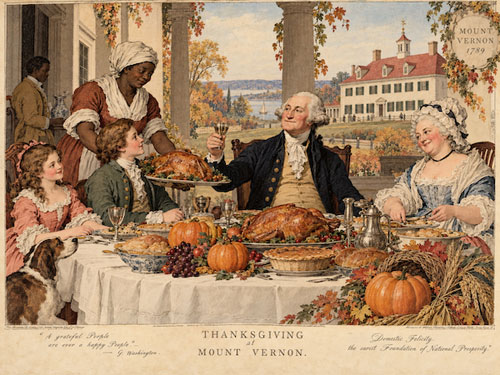
George Washington issued a Thanksgiving proclamation in 1789 to give
thanks for the new U.S. Constitution. It was celebrated that year and
sporadically by Americans in the following years, but it was almost
another 75 years before it became a national holiday.
It took the persistence of Sarah Josepha Hale, one of the most well
-known magazine editors and influencers of her time to take the turkey
by the gobble and get it on the platter. Her crusade began in 1827 and
took twenty-seven years of campaigning, through five presidential
administrations with lots and lots of letter writing. Mrs. Hale is hardly a
household name because of her trottings for turkey, and her true legacy
is ultimately as a poet. She was the writer of the children’s ditty, “Mary
Had a Little Lamb” in 1830. (Two years before her death in 1879, the
poem was recited by Thomas Edison and became the first recording
played on his newly invented phonograph.)
The letter writing paid off in 1863, the second year of the Civil War. Mrs.
Hale, a longtime abolitionist, even felt that this holiday may help to
bring the North and South together. No such luck.
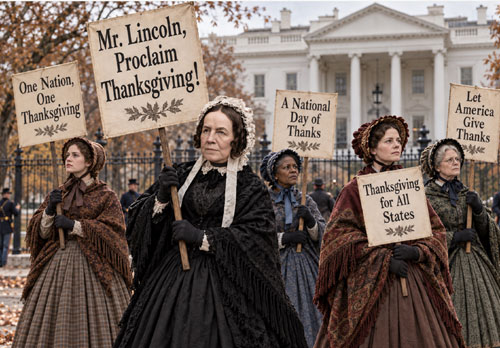
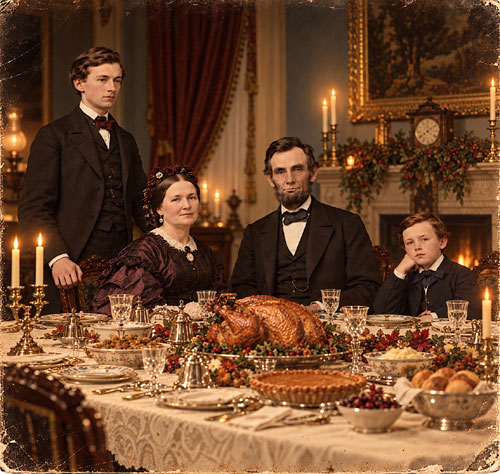
The war lasted another two years but President Lincoln issued a
proclamation setting aside a National Day of Thanksgiving the final
Thursday of November. He also hoped feasting might help ease
hostilities. There is documented evidence that five states celebrated the
holiday after the proclamation: California, Kansas, New York,
Pennsylvania, and Maine. Southern states set their own dates.
One would hope that two Thanksgiving proclamations by two Mount
Rushmore titans would be all that was needed to add this bold letter day
to those kitchen wall calendars. No, it was not to be. It would take one of
our wealthiest, yet most socially conscientious presidents, undoubtedly
with his wife’s urging that the holiday became official after some chaotic
events. (And we thought the first Thanksgiving with those sort-of
newfound landers could have ended up a food fight.)
In 1939, President Roosevelt under pressure from retailers, proclaimed
that Thanksgiving would be the third Thursday of November rather
than the fourth one which was November 30th that year which would
not allow for enough shopping days until Christmas. Some states balked
at this change and celebrated Thanksgiving on the traditional date. So,
from 1939-1941, Thanksgiving was celebrated on two different dates.
Twenty-two states followed the president’s mandate, twenty-three
partied on the traditional date and three states, Texas, Colorado and
Mississippi threw in the dish towel with the cross stitched turkey on it
and celebrated on both dates. And you thought those Chevy Chase
family holiday comedies were out of control. Imagine getting family
members from various states together on a date they would have to
agree on! At last in December 1941, Congress passed a resolution
making the Thanksgiving holiday on the fourth Thursday of November.
Roosevelt signed it into law on December 26, 1941 and Mrs. Hale could
now R.I.P. knowing everyone was now on the same page with somewhat
the same turkey and trimmings adorning Thanksgiving tables across the
lower forty eight, Alaska and Hawaii and possibly Puerto Rico and any
U.S. territories willing to admit they had anything to do with the U.S..
Many Americans say Thanksgiving is their favorite holiday. Next time
someone says that, let them know what a struggle it was to get it
officially on the calendar. Don’t even bring up all of the dates Christmas
is celebrated and why. Happy Thanksgiving!
Art of the Month
Boyhood with Gurdjieff
by Fritz Peters (1964/2019)
|