|
It may say something about the Zeitgeist that
the two biggest movie
hits of the late
spring—at least
until Steven Spielberg
released Disclosure Day, more
on that film next
month—were horror
movies that generated
enormous amounts of
existential
dread. Curry
Barker’s Obsession begins
with an innocent
romantic crush and ends
by crushing all its
protagonists through
the medium of a novelty
toy. Kane
Parsons’ Backrooms is
the first theatrically
released extension of
Parsons’ web
series of the same
title, one of the most
ambitious experiments
in the genre of liminal
horror.
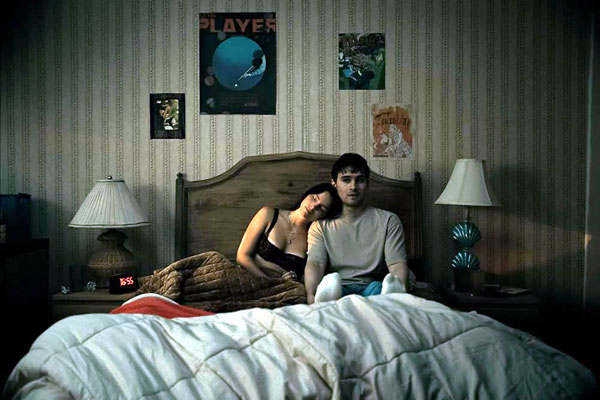
Obsession begins with a scene straight out of a teen romcom.
Baron
“Bear”
Bailey (Michael
Johnston), a clerk in a
music store, is
infatuated with
co-worker Nikki Freeman
(Inde
Navarrette). We
first see him with his
pals Ian (Cooper
Tomlinson) and Sarah
(Megan Lawless)
rehearsing lines to
tell Nikki how much he
cares. Ian
and Sarah tell Bear
it’s hopeless:
Nikki only thinks of
him as a friend.
On a whim Bear buys
Nikki a One-Wish
Willow, a stick which
supposedly will grant
your one dearest
wish. Driving
Nikki home from Trivia
Night, he forgets to
give her the
stick. As she
disappears into her
house, Bear breaks the
stick himself.
“I want Nikki to love me more than anyone,” he says.
Suddenly, Nikki reappears on her porch.
Obsession has
been compared,
rightfully, to both the
classic horror story
“The
Monkey’s
Paw” and the
witchcraft-in-suburbia
movies of Zach Cregger (Weapons). It
would give far too much
away to tell the story
of Obsession beyond
this point; let’s
just say that Bear has
no idea what to do as
Nikki’s behavior
grows ever more crazed,
and finally turns
murderous. The
adage, “Be
careful what you wish
for,” has never
been demonstrated so
horrifically as in Obsession.
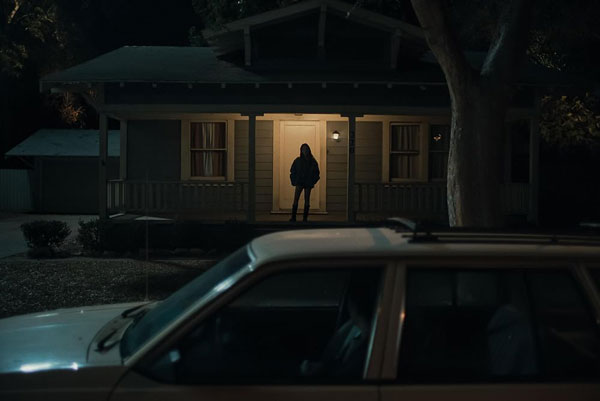
I forgot to mention that, early in the film, Bear comes home to find
his cat dead. The cat got into the Oxycontin prescribed to Bear’s
late grandmother. Regard all of this as the equivalent of a gun
brandished in the first act.
Some parts of Obsession, especially toward the end, are hard to
take, but the wit of Barker’s screenplay and the performances of
the quartet of young actors make the film well worth seeing.
Navarrette, especially, is sublimely creepy. Her scariest scene is
when she’s simply standing in the middle of Bear’s living room,
smiling; it is the most goddamn terrifying smile you will ever see.
Barker traps his characters in a world in which they meet not
destiny but fate. He includes a quietly unnerving scene in which
Bear calls the customer service representative for One-Wish
Willow. The customer rep, voiced by Barker himself, is a bored
slacker who plainly hates talking to anyone. Bear asks him how to
break the spell. “Well,” the rep says with elaborate ennui, “you
could kill yourself.” Cormac McCarthy never devised such a
brilliant metaphor for the indifference of the Universe.
Barker made a wonderful horror film at the age of 26, but Kane
Parsons went him one better. Parsons turned 21 the month after Backrooms was released, and the movie is based on a series of
short videos Parsons started posting on the Web in early 2022
when he was 16. Parsons’ “creepypasta,” or Internet-based horror
series, is based on a series of liminal horror pictures that began
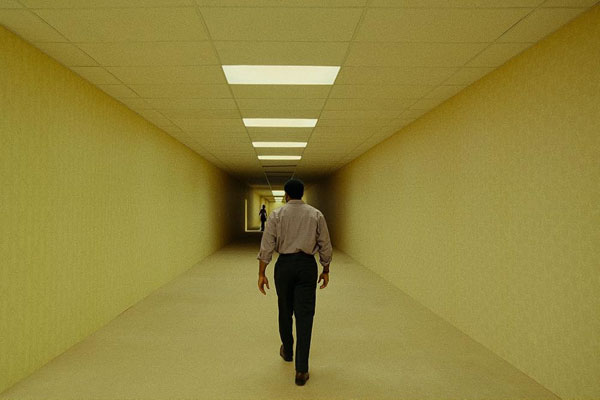
appearing online as early as 2019. It consists of 24 episodes
featuring various people lost in an interminable maze of
subterranean rooms, all painted or wallpapered in bilious yellow,
some empty, some filled with heaps of old furniture or personal
items. Ominous drawings and threatening figures are glimpsed
intermittently, and the buzz of fluorescent lighting is constant.
According to Parsons’ lore, an organization called Async Research
Institute first discovered the Backrooms circa 1990. The Backrooms movie, with a screenplay by Will Soodik, begins with a
video of an Async employee being chased to his doom. It resumes
with Clark (Chiwetel Ejiofor), alcoholic owner of a failing furniture
store, who is attending a session with his therapist Mary (Renate
Reinsve). Clark is embittered against his ex-wife, whom he blames
for his never making use of his degree in architecture. Mary—who
herself carries a great deal of trauma caused by her severely
agoraphobic mother—tries to steer Clark toward acceptance and
forgiveness, but Clark wants none of it.
Clark lives in his store, drinking himself to sleep every night. At
one point he films a TV ad for the store, dressed in a silly pirate
outfit, with the aid of assistant manager Kat (Lukita Maxwell) and
her cameraman boyfriend Bobby (Finn Bennett).
One night Clark’s TV and the store lights start to flicker. Going
down to the breaker box in the basement, Clark notices a slit in the
basement wall. He touches the wall, his hand goes through, and
suddenly Clark finds himself in the Backrooms.
To say much more about Backrooms would be counterproductive.
Plot twists must be preserved, but even more to the point is that
the horror of Backrooms exists less in plot twists and more in the
dank, foreboding ambience Parsons creates. We see labyrinth
after labyrinth of rooms unfold before us; eventually we see layer
after layer of rooms, with furniture sinking into the floors and
shafts that lead to unspeakable places. We can virtually smell the
rot and mildew, which are indistinguishable from dread and
despair.
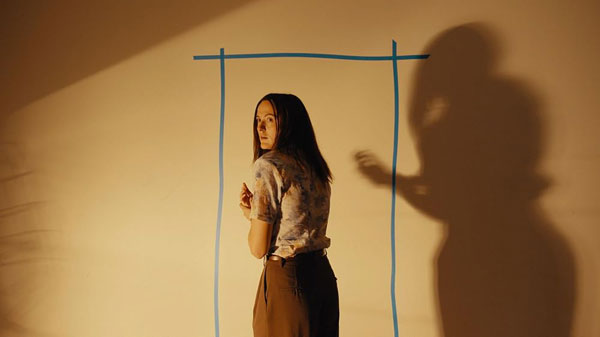
I will tell you that Mary comes looking for Clark; that Clark is by
no means the only person in the Backrooms; that the pirate motif
assumes enormous and terrifying importance; and that Phil (Mark
Duplass), an executive of Async, makes his presence known. But
the exact nature of the menace remains nebulous (all the better to
sell a sequel, or a series of sequels).
With Obsession and Backrooms, Barker and Parsons must now be
counted as two of the fastest-rising directors in the film world
today. They have already been praised by film royalty such as
Christopher Nolan, who commends their rejection of “AI slop.”
The praise is apt. It is encouraging that two young horror film
directors share the realization that true horror arises not from
blood-soaked special effects, but from human thoughts
and desires.
|