|
''I
have come to see family
history as similar to
architecture in certain
ways,'' she
writes. ''Like
architecture, it is quiet.
It encompasses, but does
not necessarily demand
attention. . . . Like
architecture, too, family
history can suddenly loom
into consciousness. . . .
—Suzannah Lessard, The Architect of Desire
As
my readers know, I have
been writing a series of
memoirs, including a
narrative of my temporary
descent into madness. I am
currently engaged in
investigating the possible
roots of my mental health
issues in my
father’s family
lineage. My excellent
consultant and writing
coach Randon Billings Noble (whose writings I highly recommend) suggested that I read Suzannah Lessard’s The Architect of Desire as an example of writing about a generational heritage of trauma. I am not here reviewing the book—it’s 30 years old and Lessard passed earlier this year. But I want to describe it with the intent to recommend it strongly for any reader interested in memoir, especially family stories, or American cultural history, since the family under review here is Stanford White, the great American architect, and his descendants.
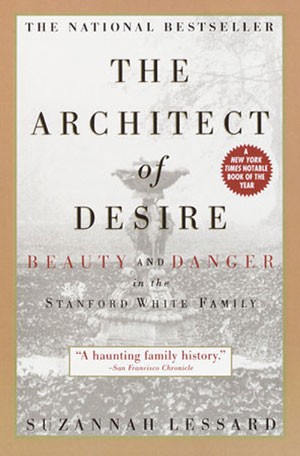
White, considered by many the greatest architect of his time,
was the creator of many beautiful buildings, including among
others the original Madison Square Garden, stunning
interiors, and fine landscapes. Unfortunately, his lust for
beauty was not limited to buildings or art objects. He was a
notorious sexual predator, primarily of young girls. It was this
proclivity that led to his murder by Harry K. Thaw, another
dissolute denizen of the era’s upper class. Sadly, White was
part of a circle of fine artists and creators who exploited girls
for sexual pleasure, not unlike Jeffrey Epstein and his cohorts
in our time.
Stanford White’s story is well known, featured in popular
culture in such productions as E.L. Doctorow’s novel Ragtime and its film version. If unfamiliar, one can easily read up on it
online or in any of several biographies.
It is not this oft told tale that makes The Architect of Desire so
compelling—though Lessard’s personal slant is certainly of
interest. Rather, it is her story of the generational
repercussions that persisted down the subsequent generations
that creates this compulsively readable book.
White’s fatal proclivities seem to have cast an inescapable
darkness over the family, enhanced by—to put it
mildly—eccentricities introduced by the other families that
married in. White’s descendants and their families continued
to live at Box Hill, known simply as The Place to its residents,
on Long Island. Lessard describes beautifully the mixture of
the beautiful and uncanny that comprised The Place.
Paradoxically, one felt secure and endangered simultaneously
within its bounds. Visiting Stanford White’s still extant
buildings brought the same frisson triggered by the contrast
between their beauty and the sense of threat hanging in the
air.
Lessard relates in alternating chapters the story of White’s life
and murder and its ongoing effects within the family. She also
devotes some interesting attention to Harry K. Thaw, White’s
assassin, and provides a particularly welcome narrative of the
life of Evelyn Nesbit, the proximate cause of the murder.
Remarkably, Nesbit survived until the age of 82, eventually
escaping the Stanford White curse, though not unscathed.
I found this book almost impossible to put down, in part due
simply to the quality of Lessard’s prose and her wonderful
descriptive ability. Moreover, the story, moving from distant
past to the present of Lessard’s life cannot fail to hold the
reader’s attention.
But ultimately I was most moved by the way she carefully
traced the effects unleashed by White’s life and death through
the lives of her ancestors and familial contemporaries.
Reading this book gave me some new ways to think about the
generational trauma that has afflicted my own family. While
nowhere near as dramatic as the White family’s, there is a
darkness hovering over several previous generations that we
are only now in my generation emerging from. Much of the
Luce family history prior to my father’s existence is murky. I
am researching for information using such sources as
Ancestry and some historical record regarding my great-great
-grandfather, who was something of a public figure in mid-
late-19th Century Massachusetts. I look forward to sharing my
findings in future writings.
|