 |
|

|
|
||||||||||||||||||||

|
|
|
Kandinsky’s Creativity:
|
|
|
|
Introduction Readers here may know that I came to Kandinsky not only through his paintings but also through his writings for and about the theatre. When I started professionally to train actors at U.C. Berkeley in 1981, my many prior years of training and stage experience gave me the inklings of an approach. But I found that the prevailing methods of training, popular and persistent in that heyday of the acting studio culture, left me cold, and didn’t come close to describing what I knew to be involved in inhabiting a dramatic script. But how to teach that? Kandinsky came to be the touchstone for my long teaching life—directly through his overarching thinking about the theatre and performing, and indirectly through his own approaches to painting and to training painters. I found that, by analogy, his exercises, priorities, and language perfectly described the work of both an actor and an acting teacher as I knew them. Kandinsky wrote: “The measure of a student’s sincerity shall be the quality of his tools.” This deceptively simple thought became the motto for my own theatre studio, opened in 1985. In the Preface to one of his autobiographies, Early Stages, Sir John Gielgud described some of those tools: “It was many years before I began to understand anything of the selective control and technical skill needed by an actor… the art of diction, timing, rapport with other actors, pace, clarity, style, the means of reproducing a part continually over a number of performances… I found it very hard to concentrate… and work at [my part] doggedly in order to perfect it.”
Over the years, I worked
“doggedly” to give
theatre artists those skills and
more. But surely the most
elusive, foundational
“tool” to teach is
creativity. Gielgud was born
into an environment where the
creative impulse was the oxygen
breathed. I had no impulse to
browbeat anyone with the
injunction to * * *
Kandinsky’s Creativity: When it comes to Kandinsky, there seems to be no end to the discoveries one can still make about this extraordinarily creative, interested-in-everything, multifarious personality. Even after all these years, still far from everything is known about Kandinsky.
What was the source of Kandinsky’s creativity in so many
Along with his humor and affinity for naïve art, Kandinsky had a predilection for the primitive, for the intuitive creation, like that found in the African art that Picasso and others collected. Kandinsky’s unusual interests were at the fore when he and the much younger Franz Marc selected the 141 images for the Blue Rider Almanac (pub. 1912), their interdisciplinary volume that also contained fourteen articles on complementary, cutting-edge topics. Ultimately, 88 of the illustrations they chose featured “primitive” and children’s art, as well as naïve pieces from the South Pacific, folk puppets, woodcarvings and even art of the mentally ill, all from a range of countries and eras. In fact, Kandinsky included more examples of the naïve painter, Henri Rousseau, than of his own or Marc’s paintings! It was a priority for Kandinsky to show the “inner connection” between the childlike, the naïve, the folk, and the “Primitives.” Above all, he hoped the emphasis on these would serve as a direct path to the source of all Art, to creativity. And how he loved children’s art. Kandinsky owned a remarkable collection of children’s art, containing at least 250 drawings. In the Blue Rider Almanac, he highlighted this love in an essay entitled “On the Question of Form”: “the unconscious, enormous power of the child… [is] often of greater value than adult art.“ He was especially drawn to the art of very young children, before any influence or teaching had been exerted: “The Academy is the surest way to ruin juvenile talent!” And this: “the artist who in many ways is like a child, can much more easily reach the inner sound of things." In his brief autobiography of 1913, Reminiscences, Kandinsky put his finger aptly on what it means for the artist to be “like a child,” to observe the world through the lens of heightened curiosity. In this poetic passage, we see the gifted writer in Kandinsky as he describes his youthful experience of the “innermost being, the secret soul,” of everything: … not only the stars, moon, woods, flowers of which the poets sing, but even a cigarette butt lying in an ashtray, a patient white trouser-button looking up at you from a puddle in the street, a submissive piece of bark carried through the long grass in the ant’s strong jaws to some uncertain and vital end, the page of a calendar, torn forcibly by one’s consciously outstretched hand from the warm companionship of the block of remaining pages. Another instance of the childlike perspective to be fostered: in a long poem, handwritten by Kandinsky in Russian and German, the hero is a Road that vividly describes its adventurous descent around curves, avoiding accidents over tree roots, up steep hills where it almost stalls, all along exclaiming its despair, and so on. Apparently, for Kandinsky, to be creative and to experiment, to arrive at the essence of Art, its “universal language,” its source, it is inevitable that one will keep some of childhood’s characteristic poetry and hilarity.
Kandinsky's distinctive
humor is all too rarely what
people learn about him. Both
specialist and popular sources
have established an
“image” of him as a
Serious Person. This may account
at least partially for why those
funny “microbe
shapes” of his final
period, so different from his
earlier periods, have been
dismissed for such a long time.
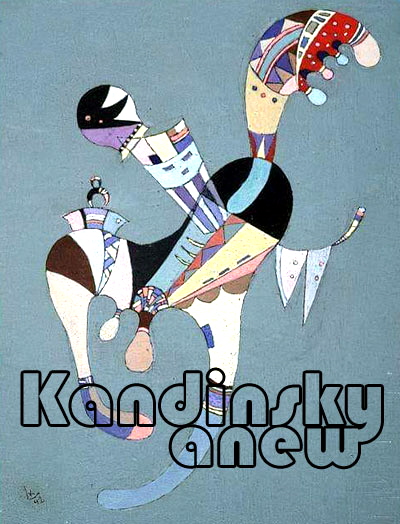
“Fluttering Figure”
of Kandinsky’s contemporaries knew best: his friend, Gustav Freytag, son of the famous writer, gave an extensive description of the many hikes they took together into the Alps, of how fun the excursions were and how much he and Kandinsky laughed. Freytag seems to have explicitly mentioned Kandinsky's good humor and his readiness to laugh. The painter August Macke also wrote a letter about a gathering at which there was a lot of general laughter, specifying that "Kandinsky had a Homeric laugh.” In a 1983 interview for Art Journal, Vincent Weber looked back on what Kandinsky’s teaching was like when Weber was his student at the Bauhaus. Weber remembers Kandinsky’s stimulating teaching, often full of pantomime, and tells this endearing story: "How Kandinsky chuckled at the arrangement of a still life consisting of a coffee pot, a small milk jug and a sugar bowl... ‘Not very exciting. Therefore we must bring eccentricity into the arrangement and the positioning. Look at the coffee pot: fat, stupid and haughty. She has a very arrogant air when we turn her a little sideways and draw her snout still higher. Now the little milk jug: small, modest. It looks humble if we turn it down thus at an angle. An obeisance before the powerful coffee pot! And now the sugar bowl: satisfied, fat, well-to-do, content because she is full of sugar. She laughs when we put her lid on at an angle.'" Along with all these glimpses of the authentic creativity Kandinsky enhanced in himself and others, it is interesting to have an example of creativity that is false, forced, or inauthentic. Here, Dr. Hahl-Fontaine, one of your two authors, contributes a lively firsthand account of Otto Hofmann, a former Bauhaus student. She writes:
“Kandinsky’s letters
to Hofmann are typical in
showing that he spent half his
life helping just everybody!! In
Hofmann’s case, first
Kandinsky helped him find a
teaching job, then invited
Hofmann to Paris, praising his
paintings—but only having
seen them in photos. Typically
this
“follower”—
actually “In 1993, I organized a week-long show with lectures and panel discussions under the title ‘What does Kandinsky still have to say to today’s painters?’ This was jointly sponsored by the Royal Museum and the Goethe-Institut of Brussels. Completely by chance, the latter had an Otto Hofmann show. When I saw those harmless, uninspired, small “Klees” and “Kandinskys,” I was furious!! When I interviewed Hofmann for the “What does Kandinsky…” program, I asked him what he thought about Kandinsky’s key expression, “inner necessity.” Hofmann understood the criticism implicit in my question, and answered rightly that this is the most important belief of every artist—but, he went on, living in East Germany he had been somewhat hindered… But by then he was living luxuriously in Southern France at the Mediterranean Sea, and was continuing to sell his imitations very successfully. What a horror!” All in all, we can see that the thread of creativity ran through all of Kandinsky’s life in one form or another. As a boy, when all the families with all their children came together, it was always Kandinsky who organized the theater performances given by the young people and small children. As an adult, once during a visit to Odessa he wrote to his longtime companion, Gabriele Münter, that he was building an airplane for one of the boys. In 1937, in his later life, he mentioned in a letter that he’d been to the circus, as if it were a usual outing: “Yesterday I met by chance Mrs. André-Loewe at the Circus.” Ultimately, the creativity of the artist is like that circus animal in Kandinsky’s “Fluttering Figure.” As artists we “ride” creativity, not knowing quite what kind of being we ourselves are, or even what kind of creature we are riding: is it a pony? an elephant? neither? both? We hold on as gaily as we can, partly guiding an impulse, partly guided by it; fluttering somewhere between pleasure and mystery. |
|
|||||||||||||||||||||||||||||||||||||||||||
|
|||||||||||||||||||||||||||||||||||||||||||


|
||||
|
|
|||||||||||||
|
|||||||||||||

|
||||||||||||||||||||||||||||||||||||||||||||||||||||||||||||||
|
||||||||||||||||||||||||||||||||||||||||||||||||||||||||||||||

|
|
|
|