|
No
doubt if Oscar Wilde
had still been swinging
in The Swinging
Sixties, he’d
have adored the songs
of Donovan Phillips
Leitch, better known
simply as Donovan. Take
the Scotsman’s
diction—as
formidable as a
poet’s—or
the precision of his
pronunciation, whether
spoken or sung and
adorned with Glaswegian
inflection and rolling
r’s. Check out
“Wear Your Love
Like Heaven” for
the former,
“Atlantis”
or “Season of the
Witch” for the
latter.
Wilde would’ve also certainly enjoyed Donovan’s sartorial sense.
At a deeper level,
Wilde would have felt
an artistic kinship
borne of geography and
culture. Oscar was
profoundly Irish,
Donovan deeply Scottish
but also a fellow
Hibernian by dint of
his grandmothers, both
of whom hailed from
Ireland—so,
Celtic myth and
folklore, landscape and
weather, and the mutual
misery of centuries of
English
oppression….
Histories of ages past,
Unenlightened shadows cast
Down through all eternity
The crying of humanity —
’Tis then that the Hurdy Gurdy Man comes
singing songs of love.
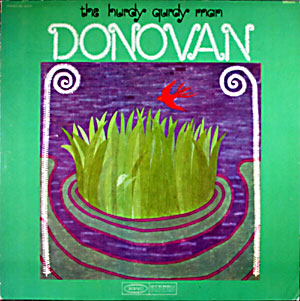
The Hurdy Gurdy Man, Donovan’s sixth studio album, was
released in October 1968. Eclectic, ambitious, whimsical,
mystical, powerful, intriguing, and altogether entertaining, the
album is like strolling through a bazaar at a continental
crossroads, merchants haggling in a dozen dialects, and
everywhere the eye arrested by the rich textures and intricate
patterns of exotic fabrics—from paisleys to tartans, Banarasi
brocades to mulberry Charmeuse.
The eclectic mix of songs and their often startling juxtapositions
builds on an innovation recently pioneered by Donovan’s four
close friends from Liverpool. The massively “heavy” title track
opens the record; after it trails off, a distinctly medieval drone
starts up—our friend the hurdy gurdy—to kick off “Peregrine,”
a variation of an ancient Scottish Folk song addressed in mystical
friendship to a falcon. The transition rivals The Beatles’ brilliant
move from “Within You Without You” to “When I’m Sixty-Four”
on Side 2 of Sgt. Pepper’s Lonely Hearts Club Band.
Musicologists had already coined the term “World Music,” but
artists, record store managers, and listeners wouldn’t start using
it until the 1980s. Donovan was way ahead. Much the way Roger
McGuinn intended Sweetheart of the Rodeo as a survey of
American musics, The Hurdy Gurdy Man is a conspectus of
global traditions—Jazz (“As I Recall It”), Folk (“The Entertaining
of a Shy Girl”), Raga (“Peregrine” and “Tangier”), Calypso (“West
Indian Lady”), Burlesque (“Get Thy Bearings”), even children’s
music (“The Sun is a Very Magic Fellow”), and a pinch of
psychedelic.
The array of instruments used on the record comprises a
veritable World Music orchestra: alongside conventional drums,
piano, and acoustic and electric guitars and bass, you’ll hear
bongos, cello, congas, Cor anglais (AKA English horn), flute,
harmonium, harp, harpsichord, saxophone, sitar, tabla, tambura,
and, of course, the hurdy gurdy.
So, what exactly is a hurdy gurdy? Imagine a lute, but instead of
plucking or strumming the strings, a hand crank turns a rosined
wheel spinning perpendicularly to and in constant contact with
the strings. A precise date or place eludes historians, but the
hurdy gurdy shows up on the scene in Europe in the 11th or
possibly 10th century, perhaps an ancillary invention of the
medieval industrial revolution already in full swing by that point.
Early in the film The Song Remains the Same, Jimmy Page can
be seen playing one while reclining on a Persian rug by a pond in
the English countryside.
In meaningful ways, Led Zeppelin and The Beatles cross paths on The Hurdy Gurdy Man. As mentioned, Donovan was great pals
with the Fab Four and joined them at Maharishi Mahesh Yogi’s
ashram in the Himalayan foothills of Rishikesh for a
transcendental meditation retreat. It’s there that Donovan taught
John Lennon the Travis picking technique on guitar which
Lennon used to lovely effect on “Dear Prudence,” “Julia,” and
“Happiness is a Warm Gun.” It’s there that Donovan wrote the
song “Hurdy Gurdy Man.” At Rishikesh, George Harrison gave
Donovan a tambura, as well as another stanza for his newly
written song (Donovan has routinely sung the additional verse
when playing live but omitted it in the studio version for time
considerations.) And it’s at Rishikesh that Donovan co-wrote
“The Sun is a Very Magic Fellow” with Beatles friend and roadie
Mal Evans.
Back in England in the recording studio, sought-after session
man John Paul Jones played a large part in crafting The Hurdy
Gurdy Man. The soon-to-be Led Zeppelin bassist served as
musical director and arranger, booking the other session
musicians, shaping the sound of the songs, and playing bass on
the title track. Contrary to compelling legend, Jimmy Page and
John Bonham did not play on the song “Hurdy Gurdy Man.” But
five years after The Hurdy Gurdy Man, the lads in Led Zeppelin
deployed the eerily mystical drone of “Peregrine” on “In the
Light” to start off Side 3 of Physical Graffiti. Naturally, Jimmy
took it to 11 by doubling the instruments with a slight delay, a
brilliant touch that never fails to dazzle.
The Hurdy Gurdy Man meets my Perfect Album criteria in many
ways. Melodic hooks, sonic textures, unexpected phrases—every
song pleasures the ear while engaging the mind. Perhaps it’s
contradictory, but Donovan will get you dancing even while he
always makes “smart” music. Maybe it’s not contradictory at all.
And such versatility: it’s superb music for Monday night’s dinner
at home or Friday evening’s cocktail party, a soundtrack
guaranteed to transform room and board. And it’s a nourishing
album for very young minds: kids love it!
Wilde might have enjoyed“Jennifer Juniper” most, given its art
-for-arts-sake sensibilities, its lovely chamber music
orchestration, and its sonorous shift to French lyrics in the last
verse. As for the exquisite shaman behind the album, when he
wrote his life story he chose to call it: The Autobiography of
Donovan: The Hurdy Gurdy Man.
Here is the original album playlist:
Side 1:
Hurdy Gurdy Man
Peregrine
The Entertaining of a Shy Girl
As I Recall It
Get Thy Bearings
Hi It’s Been a Long Time
West Indian Lady
Side 2:
Jennifer Juniper
The River Song
Tangier
A Sunny Day
The Sun is a Very Magic Fellow
Teas
|