|
A new exhibition at the Folger Shakespeare Library
reveals unexpected diversity in both Shakespeare’s London
and in his ongoing influence.
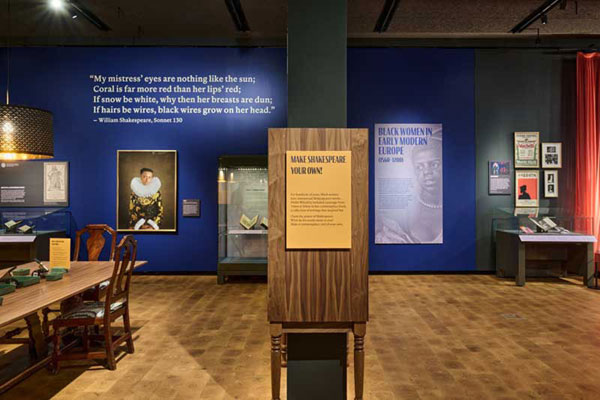
Thanks once again to Colleen Kennedy, Senior Communications
Manager at the Folger Shakespeare Library in Washington, D.C., I
was able to preview a remarkable new exhibition inaugurating the
Library’s recently reopened exhibition space. Entitled To Hear Her
Speak: Black Women and Shakespeare,this show demonstrates that
Shakespeare’s London was not as lily-white as some might imagine
but in fact included persons of numerous nationalities and races.
The starting point for visitors is a map documenting the locations of
a number of Black women alongside various sites associated with
the Bard.
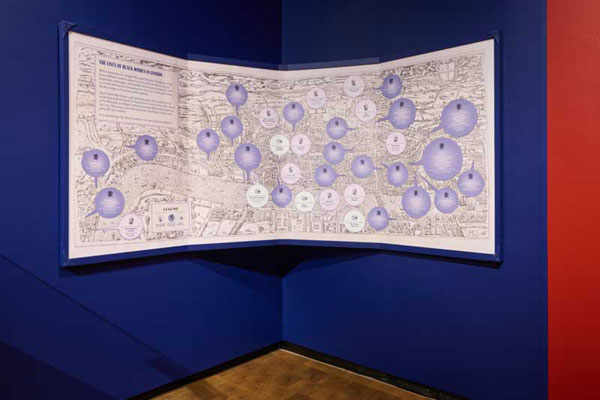
The show goes on to demonstrate the many ways Black women
artists, writers, actors, and scholars have been affected by his work
and in turn have broadened our own understanding of it.
Among Shakespeare’s plays, only Othello contains an overtly racial
theme. And its treatment of the issue is not straightforward either as
an expression or condemnation of racism. (I recently reviewed a
production of the play that makes much of its ambiguity regarding
race.)
But this fact has not deterred his continued influence and
inspiration for Black readers and writers. Indeed, the show’s
curator, Dr. Patricia Akhimie, noted scholar of Shakespeare, the
early modern world, and race, drew inspiration in part from one of
the Bard’s best known and loved sonnets, No. 130 (“My mistress’
eyes are nothing like the sun”). Line nine of the poem provides the
title of the exhibition: “I love to hear her speak….” The traditional
reading of this sonnet, in which the poet catalogues the many
qualities of the beloved that run exactly counter to conventional
descriptions, is that Shakespeare is gently mocking convention by
enumerating virtues that run counter to what would be expected in
a love poem of the time.
While this interpretation is inarguably valid, Dr. Akhimie points out
that several of the attributes singled out for praise—pale lips, dun
breasts, hair like black wires—could also describe a Black woman.
(And remember that the apparent recipient of these sonnets is
known as the “Dark Lady.”) It is impossible to know Shakespeare’s
attitudes and beliefs regarding race, but it seems likely they were
not far out of sync with those held by white males at the time.
Black women in Early Modern Britain, as elsewhere and in other
times up to the present, were regarded with great ambivalence.
Desired for their exotic beauty, their perceived sexual potency, they
were naturally also thought of as less than fully human, best suited
for work (including sex work).
Nevertheless, brilliant and creative Black women in the succeeding
centuries have embraced the Bard’s work as inspiring, challenging,
and as much a part of their artistic heritage as that of white men or
women.
The exhibition demonstrates this fact through many artifacts,
writings, and films. One part of the show features photographs,
posters, and newspaper clippings about all-Black productions of
Shakespeare’s plays, including some that were also all female.
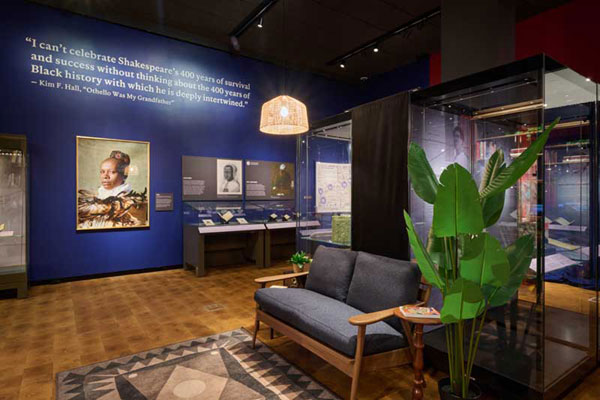
Most fascinating of these is a poster and information about a
performance of Richard II, in which the title role was played by
Black actress and director Adjoa Anjoe (who is serving as chair for
this exhibition and provides the narration for its audio tour).
Also featured in the show are Black women writers who found
inspiration in the works of the Bard. The artifact that, as a poet
myself, I personally found most touching is a copybook that
belonged to Phillis Wheatley in which she had written down lines
from Shakespeare and her own thoughts about them.
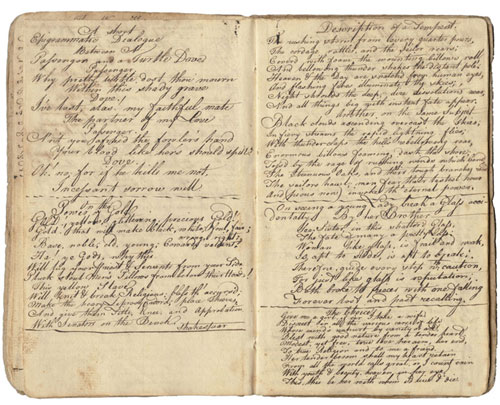
It was especially moving to see that Wheatley, not only the first
Black female American poet but in fact one of our country’s first
major poets of any race or gender, found sustenance and
encouragement from the supreme English poet.
Similarly such modern figures as Maya Angelou and Toni Morrison
have been spurred by their encounters with Shakespeare in their
own pursuits. Angelou relates that when she first heard Sonnet 29
(“When in disgrace with fortune and men’s eyes), she felt that it was
addressed specifically to her. Morrison composed a play called Desdemona, about the tragic character in Othello, a copy of which
appears in the exhibition along with some of her notes for it.
With nearly 100 objects on display and so many themes explored, I
can’t begin to cover everything that makes this show so compelling
and necessary. It is scheduled to run through May 2, 2027, so if you
are in or near the D.C. area or planning a trip in that time, this show
is a must see. If you are unable to visit in person, take a look at the
Folger’s website. You can also listen to a playlist specially curated
for the exhibition.
Come back here next month when I report on another of the
Folger’s many wonderful offerings.
Exhibition photographs by Tim Tiebout.
|