|
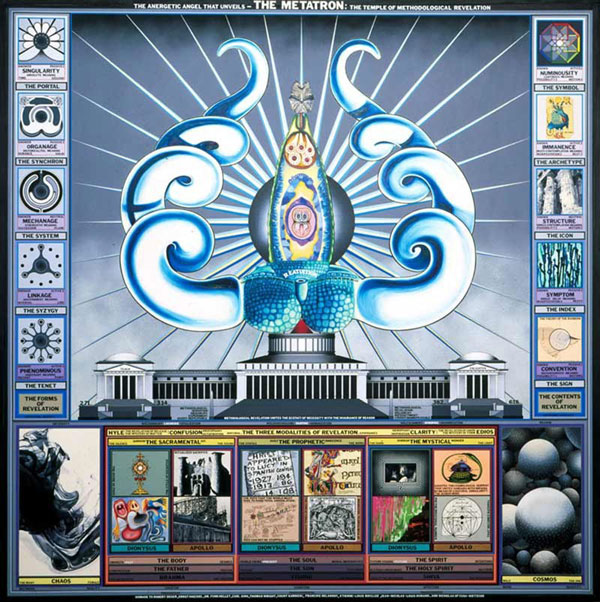
Paul Laffoley, The Metatron, 1977
It is certainly odd: that even though some part of ourselves may
be living in the future, our predictions are far more likely to be
wrong than to be right. To see would demand that we
acknowledge what we see, only to then catch ourselves off guard.
To see would be to predict that we will die, to accept that we just
did, to then believe the Ancients when they say that death is both a
journey and a challenge, for which we must prepare.
If release brings joy, both after death and in daily contemplative
flashes, this joy may be only a test, a pause to strategize the terrain
of a coming war. To see would be to search the depths of
knowledge beyond peace. To see would be to set aside each body
in turn, not just the physical one we are used to. To see would be
to challenge each false ruler of the cosmos. “I know you—fill in
name of Gnostic archon—for I am of those from above!” To see
would be to fall like light through outer space. To see would be to
give, to whomever, wherever. It would then be up to the recipient
to throw away the gift. To see would be to begin beyond the end,
to laugh. To see would be to remake ourselves in the image of
what sees.
If there are forces that may actively attempt to block our view, our
own sense of false humility may be a bigger factor. Real humility
creates openings; the false type shuts them down. If prophesy
does depend on our ability to see clearly into the moment,
whatever this moment might be—to boldly recognize patterns that
are just beginning to emerge or to probe into patterns that have
long been in existence, but which, for whatever reason, have not
yet become visible—then our success may come more from a set of
classical virtues than from a bag of occult powers. We have only to
differentiate real virtues from their substitutes.
To be virtuous, as I use the word, is not necessarily to act well. No;
it is only to be conscientious in keeping our heads clear, to act well
enough to be of service to our vision. In the morning of the world,
there were those among our teachers who had said, “Let us break
you, just a little.” Our lifespans were shrunk. A fog was attached to
our eyes. We were taught to count to count from one to two. To be
virtuous was to choose between them. Well, enough of that. There
are other sorts of virtues. Should we once more make our vision
circular, we may find that our powers are equal to our ends.
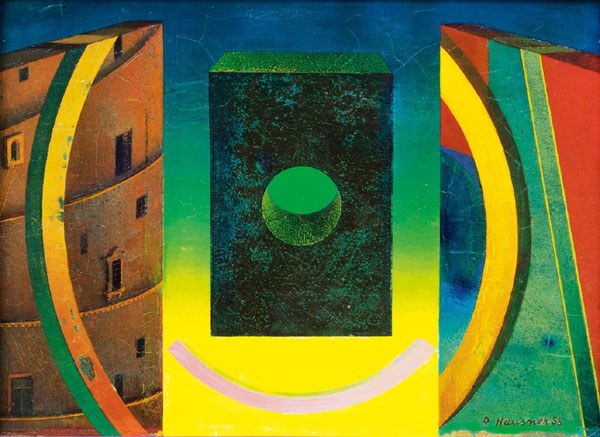
Rudolf Hausner, Black Stone, 1995
Let me call these virtues the “Anamnesian Virtues.” These are real
virtues, however much they have been formatted by an artificial
author. Their names are common, like the days of the week, yet a
shadow has fallen between one culture and the next. The original
definitions do not correspond to ours. To the extent that they
remain on this side of the existent, we must acknowledge that they
are fragments from a long since vanished text, which was copied
and then recopied into half a dozen languages before once again
being lost. Such a text is obviously prone to mistranslation, if not
self-serving paraphrase. Let me nonetheless present my attempted
reconstruction. The seven virtues are as follows:
1) Detachment:
the capacity to see the ocean that will swallow
up all things, and to listen as it whispers in your ear. You should,
paradoxically, become even more empathic as the degree of your
detachment grows. You may act on this, or not. You may spill your
blood as a purely symbolic gesture, in service to those humans yet
unborn. You may feel the pain of the multitudes that you kill.
2) Foresight:
the capacity, while still in love with life, to be dead,
and productively so. So too, the longer you are dead the more
alive you will be.
3) Self-reliance:
the capacity to stand on your own as you free
yourself from the force-fields of the common wisdom, and then
not complain too much. This will be more of a challenge if your
head, hands, heart, and feet have been removed. Most prostheses
will require some amount of training, after which you will become
100 percent free.
4) Balance:
the capacity to see the right in every wrong, as well
as the wrong at the dead center of each right. By the blinding light
of the hypersphere, we can see that even the most generous of our
actions is a crime. At one and the same moment, every crime can
be regarded as a type of revolutionary act, as a flawed but useful
reinvention of the law. Strange indeed are the methods of the
stern Goddess of Necessity!
5) Hindsight:
the capacity to remember just when to shut up, the
instinct to leave the most important details out, and the
knowledge that you have seen these things a great many times
before. To all others has a role and a position been assigned; to the
seer, only the pathos of descent.
6) Stealth:
the capacity to bring your full energy to a project
when there are few who understand what you are doing, and none
who will reward you. Only in this way will the dead be prompted
to grant access to their libraries.
7) Simplicity:
the capacity to make do with whatever Fate
deposits. We must do what we were meant to do. We must go
where we are meant to go. The shortest distance between two
points, however, may turn out to be a labyrinth. We must read
each accident as a catalytic cue in order to discover the true
outlines of our work.
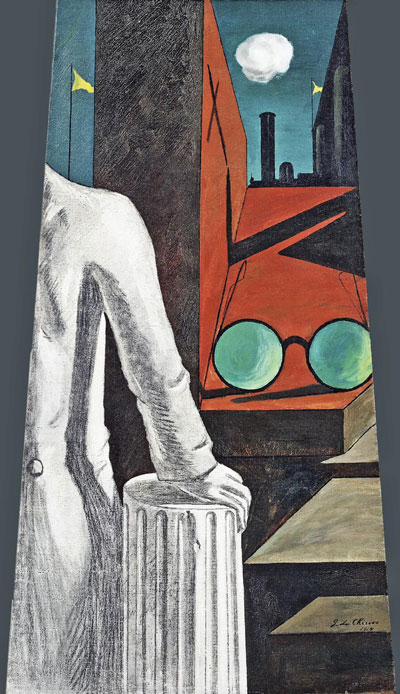
Giorgio de Chirico, The Serenity of the Scholar, 1914
There is a fog that drifts through the City of the Oppressors, from
whose spell we must free ourselves. Such an act may not increase
our personal wealth or popularity, of course; thus our progress
may seem to others the very definition of failure. A “win-win”
solution may not be in the cards. If we do decide to act, these
virtues may help us to develop the breadth of vision that we need.
They are of use to both the solitary artist and the multitude. No
line divides the subject from the object. “One thought fills
immensity,” as Blake argues in The Marriage of Heaven and Hell.
Even good habits must be probed and then, finally, dismantled. All
crutches must be thrown away, as we free ourselves from the
advice of experts, from the urge to see our side win and the other
side destroyed, and from the high-tech wet-dreams each day
generated by the media. At the end, there should be nothing left
but space.
Conversely, we must have the courage to accept that we do not, in
fact, create our own reality. For the “You” is inextricably bound to
the experience of the “We.” The “Body Politic” is an actual body,
however much we might choose to view it as a metaphor. One
victory leads to the next, smartphone upon smartphone, upgrade
upon upgrade, until the spell of neoliberalism has left no tribe
untouched. You are one of 8 ½ billion being swept along through
the veins of a metastasizing empire, whose reach is
interdimensional in its scope, but whose key principle, at the
moment, is nowhere to be found. Its search engines troll for
evidence that it has not ceased to exist, as there, just up ahead, the
ghosts of failed superbeings beckon from the fallout.
|