|
How
established is the
espionage novel as a
genre? Tim
Shipman’s
Spybrary website lists
his picks of the top 125 spy
novelists of all
time. In this
review it is enough to
note that Mick Herron,
whose novels form the
basis for the Apple TV
series Slow Horses, is
Number Eight on
Shipman’s
list. John Le
Carre, whose novel The Night Manager inspired
the BBC One-Amazon
Prime program of the
same name, is Number
One.
(“Well, who else
was it going to
be?” Shipman
writes.)
The Night Manager, adapted for TV by David Farr, and Slow
Horses, adapted by Will Smith (not that Will
Smith) and a stable of
writers, share the
theme of agents working
on the fringes of
British security
services. Those
agents, ignored and
even despised by their
superiors, face
horrifying danger
fighting the enemies of
the British
state. Often
those enemies are the
very superiors who
despise them, and who
are more than willing
to discredit or even
kill them.
That said, the two
programs are markedly
different in
tone. Both build
up constant, at times
unbearable, levels of
tension and
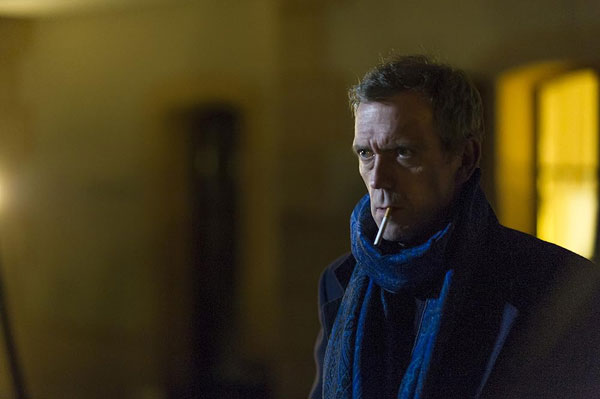
suspense. But The Night Manager is
as serious as a
military coup, with
agent Jonathan Pine
(Tom Hiddleston) locked
in a deadly battle of
wits with diabolical
arms dealer Richard
Roper (Hugh
Laurie). Slow Horses is
darkly comic, at times
even farcical, as it
details the lives and
doings of disgraced MI5
agents led by burnout
Jackson Lamb (Gary
Oldman) and hapless
River Cartwright (Jack
Lowden). The Night Manager has
an almost Bondian level
of glamor, taking place
largely in ritzy hotels
and villas on four
continents. Slow Horses marinates
viewers in the squalor
of Slough House, the
crumbling office
building to which
outcasts are
relegated. One
thing both programs
share is a high body
count.
Don’t get too
attached to any of the
characters.
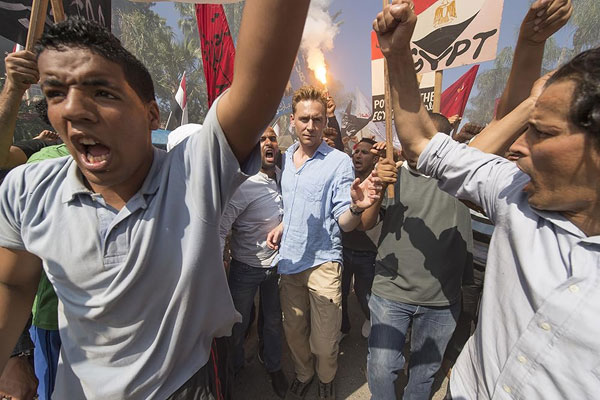
Ten years separate the first two six-episode seasons of The
Night Manager, which
begins in Cairo during
the Arab Spring
revolution of
2011. Jonathan
Pine, an Iraq War
veteran, is night
manager of the Hotel
Nefertiti, making
himself indispensable
to his guests.
One of them is Sophie
Alekan (Aure Alika),
mistress to volatile
playboy Freddie Hamid
(David Avery), who is
an ally of Richard
Roper. Sophie has
a bad conscience about
what Freddie and Roper
are doing, and gives
Jonathan a list of
their illegal
transactions, which
Jonathan transmits to
Angela Burr (Olivia
Colman), an MI6
department head in
London. Jonathan
falls in love with
Sophie and tries to
protect her, but Roper
is both too clever and
too vindictive.
Four years later, Jonathan is again a night manager, this time at a
luxury hotel in Zermatt. He learns of a high roller who’s coming
in with his entourage: Richard Roper. This is Angela’s cue to
come to Zermatt, contact Jonathan, and urge him to infiltrate
Roper’s entourage and bring him down—for England’s sake, and
for Sophie’s.
This is the impetus for two seasons of sexiness, sadism, and
skullduggery. I don’t want to give too much away, so I will just
name some of the main characters:
· Jemima “Jed” Marshall (Elizabeth Debicki), Roper’s
American mistress, who becomes more enamored of Jonathan the
more she learns about Roper’s business.
· Lance “Corky” Corkoran (Tom Hollander), Roper’s second
-in-command, who exceeds even his boss in cunning and cruelty.
· Lord Alexander “Sandy” Langbourne (Alistair Petrie),
Roper’s extremely accommodating financial director, and Caro
(Natasha Little), his fed-up wife.
· Rex Mayhew (Douglas Hodge), Angela’s immediate superior
and best friend at MI6.
· Sally Price-Jones (Hayley Squires), a loyal member of
Jonathan’s team.
· Geoffrey Dromgoole (Tobias Menzies) and Mayra Cavendish
(Indira Varma), senior MI6 officials who are secretly on Roper’s
payroll.
· Basil Karapedian (Paul Chahidi), Jonathan and Angela’s
staunch ally in the senior MI6 leadership.
· Teddy Dos Santos (Diego Calva), Roper’s Colombian
protégé, who has a big secret.
· Roxana Bolanos (Camila Morrone), a Colombian
businesswoman whose allegiances are, to say the least,
ambiguous.
This is a wonderful cast, and it performs up to expectations both
individually and as a whole. It is especially thrilling to see how
Jonathan and Roper strive to one-up each other, even if they
seem unbelievably superhuman at times. (“How the fuck did you
do that?” Roxana asks Jonathan after he emerges stone-cold
sober from two bottles of champagne, three fingers of single malt,
and a Mickey Finn. Jonathan changes the subject.) The stamina
and resourcefulness of Jonathan and his allies are on display at
all times, so the nihilistic shock of the second-season finale is a
real gut punch to the audience. There will be a third and final
season of The Night Manager, premiering sometime around New
Year’s 2028. The night I saw the second-season finale, I turned
away in disgust from the thought of a third season. Now, I can’t
wait to see how Farr, Hiddleston, Laurie & Co. rebuild the ruins.
If the second season of The Night Manager ends with a disaster,
the first season of Slow Horses begins with one. River Cartwright
conducts a search for a bomb-carrying terrorist at Stansted
Airport, under the watchful eye of “Second Desk” (second-in
-command) at MI5, Diana Taverner (Kristin Scott Thomas). In a
sequence that raises the audience’s blood pressure to near
-aneurysm levels, the search goes spectacularly wrong. In the next
scene, River is trudging up the creaking stairs of Slough House.
The search, it turns out, was merely a training exercise, but
River’s failure has made him a pariah. He is now one of the “Slow
Horses” of MI5, kicked aside to perform menial tasks for the
service. (Later we discover that River was set up to fail; by whom,
and why, are for you to discover.)
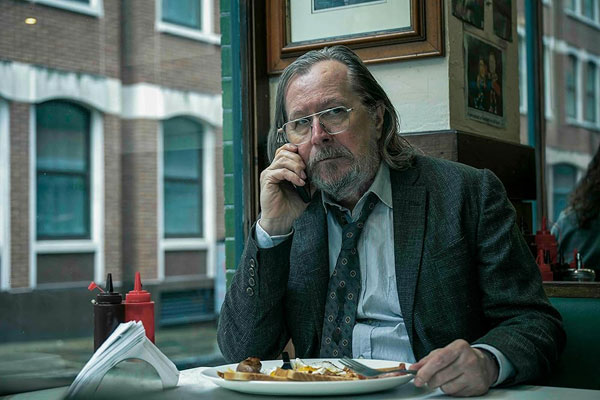
River is greeted with a tongue-lashing by Jackson Lamb, the
unkempt, boozy, farty head of Slough House. Tongue-lashings
from Jackson are a daily occurrence for every worker at Slough
House, but Jackson singles out River for the worst. River’s co
-workers are a revolving bunch, but at various times they include
bumbling Min Harper (Dustin Demri-Burns), substance abuser
Shirley Dander (Aimee-Ffion Edwards), compulsive gambler
Marcus Longridge (Kadiff Kirwan), wet blanket Struan Roy (Paul
Higgins), cadaverous J.K. Coe (Tom Brooke), and ASD poster boy
Roddy Ho (Christopher Chung). It’s obvious why all of them were
relegated to Slough House; it is not at all obvious why Louisa Guy
(Rosalind Eleazar) and Sidonie “Sid” Baker (Olivia Cooke) are
there. Louisa refuses to discuss her disgrace; in time we discover
the reason for Sid’s presence.
It is also not obvious at first why Catherine Standish (Saskia
Reeves), Jackson’s secretary, is at Slough House. The quietly
competent Catherine retains tender feelings for Charles Partner
(James Faulkner), her deceased boss, whom she found bled out in
his bathtub. But Jackson knows some secrets about Partner, as
does David Cartwright (Jonathan Pryce), River’s grandfather and
the legendary former head of MI5.
The thirty episodes (so far) of Slow Horses embroil Jackson,
River, and the other Slow Horses in plots involving explosions,
kidnappings, mass shootings, assassinations, Russian sleeper
agents, and other unpleasantries. They face these dangers
without the help, and often with the hindrance, of the agents at
MI5 headquarters, known as “The Park.” Those agents include
straight arrow Emma Flyte (Ruth Bradley), supercilious James
“Spider” Webb (Freddie Fox), and security agents Duffy (Chris
Reilly) and Hobbs (Chris Coghill), known as “Dogs,” whose chief
amusement is to beat up River whenever they get a chance.
Slow Horses’ larger number of episodes allows it to explore its
characters in greater depth than The Night Manager. The most
fascinating, which you have probably guessed, is Jackson. His
slovenly appearance hides indomitable courage, cheeky wit, a
brilliant deductive mind, and an encyclopedic knowledge of every
trick, feint, and subterfuge available to espionage agents. He looks
and even acts like a disgrace, but he isn’t: he asked to lead Slough
House, and Diana isn’t foolish enough to underestimate him.
Occasionally we have intimations that his past was unbearably
tragic, and that he values his agents more than he lets on. He
makes a veiled admission of this to Diana: “They’re a bunch of
fucking losers, but they’re my losers.”
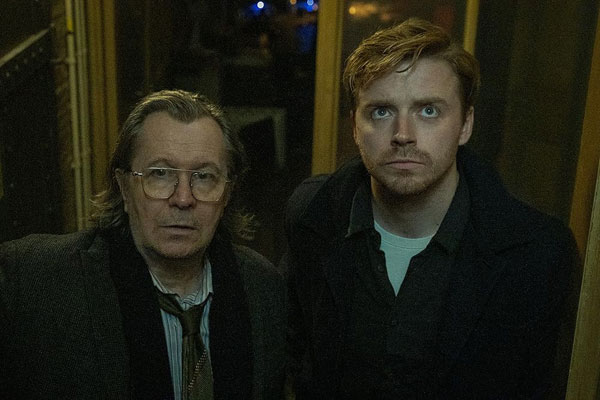
River is Jonathan Pine after Samuel Beckett and Buster Keaton
finished the rewrites. Burdened by his perceived incompetence
and his grandfather’s high reputation, River can’t catch a break.
Sometimes his own miscalculations lead him to embarrassment,
but more often he is victimized by the malice of others or just
sheer bad luck. In Season 5, a ‘Rube Goldberg’ chain of events
prevents River and Coe from fulfilling their assignment to protect
a right-wing politician from assassins. This is typical of River’s
misfortune, as is Jackson’s reaction: “The next time you cross the
street, close your eyes first!”
The best you can say about Diana is that she is less treacherous
than her boss, First Desk Ingrid Tearney (Sophie Okonedo). As
you will see, that is a very low bar. Diana has her own
tribulations: she is forced to deal with Peter Judd (Samuel West),
the venal and unscrupulous Home Secretary, and later she is
passed up for promotion in favor of clueless pencil pusher Claude
Whelan (James Callis).
There is much, much more to Slow Horses, such as the character
played by Hugo Weaving who is best left unidentified in this
review. In any case, the coolness level of Slow Horses can be
gauged by the knowledge that Mick Jagger, a fan of Mick Herron’s
novels, wrote and sang the series’ theme song. That coolness level
is raised by the presence of Gary Oldman, that most masterful
and versatile of actors, leading a superb ensemble cast. Slow
Horses is worth a subscription to Apple TV if you don’t subscribe
already. If you do subscribe, you’ll be happy to know that a sixth
season will premiere this fall, with a seventh in the works.
|