|
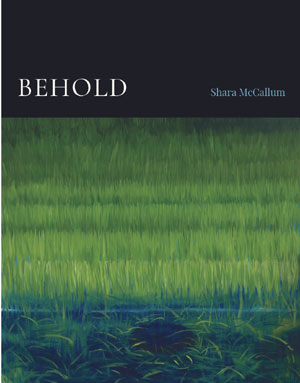
In August 2021, I had the pleasure of reviewing Shara McCallum’s
previous collection, No Ruined Stone, a masterful reimagining of the
career of Scottish poet Robert Burns had he not found success as a
poet. Speculating on Burns’ possible life as a plantation overseer in
Jamaica, McCallum explored themes of racism, enslavement,
colonialism, and sexual exploitation within the unequal power
relationship between master and enslaved.
In her magnificent new collection, Behold, the arrival of which is
cause for great joy, McCallum again treats some of these themes
refracted through different lenses. It is a much more personal book
than No Ruined Stone or that volume’s predecessor Madwoman. The poet here combines personal experience with ekphrasis to
create another remarkable collection.
The book’s epigraph from the Book of Hebrews provides both the
book’s title and an indication of its themes:
“Behold, I have come—in the volume of the book/it is written of
me—To do your will.”
It would seem that that the task at hand is, among other things, to
witness and to give a personal accounting.
The opening poem, “Passage,” draws inspiration from composer
Marta Gentilucci’s work of the same name, and sets out the poet’s
quest:
I have come
not to beg nor barter but to enter.
Who are you seeking?
The past
opens and opens, fleshing me
with loss.
I descend
to find my way,
I who am
haunted and a haunting….
How will you return to the living?
Called back by the susurrating wind and sea.
Called back by the roots of my hair, dirt
beneath my nails, the body’s sweat and stink.
Called back by their voices, yours
still clenched in my fist. Called back
to all that is matter, bone, and skin,
what fragment of you survives in me
as I open my mouth to speak?”
One path on the poet’s self-discovery journey is through art. A prose
poem entitled “Snow” relates her first encounter with original visual
art, mingling it with her first time seeing snow:
“The first museum I ever visited was the Metropolitan Museum of
Art. I was twenty years old, and it was also my first trip to New York
City and first time seeing snow. Growing up mainly in my
grandparent’s home after migrating to Miami, I’d been exposed to
visual art through my grandmother’s loves…. But, no wonder, when
I went to the Met, I made a beeline for the Impressionists. I
remember standing in front of a Renoir and realising the obvious:
how different the textures and colours of the image were in person.
I remember I kept running back and forth between the painting and
the oversized windows that looked out onto Central Park to watch
the snow that had begun falling.”
McCallum’s engagement with art is made manifest in many
ekphrastic poems that consider the work of artists who may be
otherwise overlooked. “Crop Time,” a painting by Jamaican artist
Albert Huie, evokes a not-so-distant past in the land in which the
poet was born.
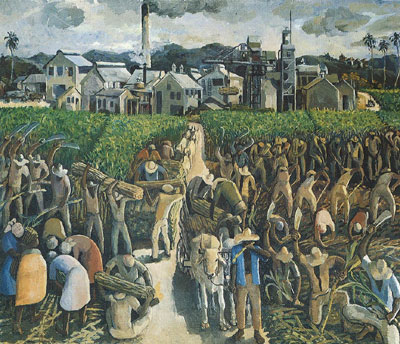
Pastoral
This is the Jamaica you were not born
into. In this field the artist has layered
bodies of labourers, hefting wrapped
bundles of sugar cane, lifting these
onto bull-drawn carts….
a grey cluster
of buildings, smokestacks, smoke
wreathing up to the sky. The smell,
that burning is in you still.
In “Self-Portrait,” the poet turns an artist’s eye to herself,
attempting to come to terms with her mixed racial and cultural
heritage. I quote in full:
At this point, I don’t know what in me is Jamaican
versus American. Or, reaching further back,
Trinidadian, Venezuelan, African, Scottish, English...
you get the drift. I thought every mickle mek a muckle
was from Kingston soil sprung, until in Edinburgh
I heard it in the mouth of a Scotsman. For years, I filed
my grandmother’s doudou as Patwa, failing to detect
Trini-French patois in her mongrel dialect.
How do you say aluminum or Armageddon? Ah, for me,
there interposes an extra syllable, an invisible I.
And why should any one I matter? is a fair question.
Only because the alternative is worse. And since
we’re on the topic of the singular, about this subject:
she’s awfully tired of being parsed to see if she’s a
fraud.
And this passage from another prose poem, “How to See”:
“When I decided to become a poet, it was after letting go the paths—medicine or, if that failed, law—I was expected to be on by
attending university. Only then, when I saw I was actually going to throw my life away, did I take two art classes.
In the first, introduction to drawing, I worked with pen, pencil, and
charcoal on paper….
The second was an advanced art history class I chose because the
time period it covered included a few of the European painters
(Impressionists) whose works I loved and, as an English major, I
thought I’d find interpretation of text to be in my wheelhouse…. My
professor, not so inclined as my drawing instructor had been to
gentle critique, plainly and continually reminded me of my lack.
Every essay was returned with a variation on this theme: Shara, you
need to learn how to see what the artist is asking and stop
imposing your own desires unto the art.”
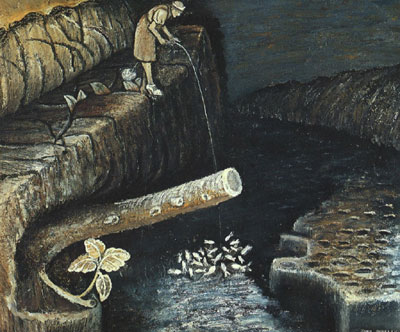
A painting by another Jamaican artist, John Dunkley, leads the
speaker into a meditation on the mythic connection between the
people of the island and its natural setting. Again quoted in full:
Parable
There is a story told of a woman
who would leave her home, her children
in their beds, to walk to the cliff ledge
jutting over the ravine. Night’s face
shone on her sometimes, dredging her
in silver light, at other turns netting her
in its lack. Long dead, a tree stump
on the bank below sprouted a leaf,
each of its veins glowing. For a time,
she became this nightly walking
to the river to lean into the dark, feeding
the fishes she could not see clustering
on the surface. Her feet practicing
this path though there was no path.
This collection is so rich and varied that as always I wish I could
share many more passages.
The poet’s journey remains unfinished but in the final poem it takes
her “On the Road to Zion,” another ekphrastic poem devoted to an
unknown Jamaican artist.
To reach you must walk backwards,
past cane fields ravelling smoke.
Pay no mind to the girl-child, roadside
in her dutty dress, transfixed by the goat
struggling against its rope. She misplaced
her soul long ago in its bleating.
To avoid such a fate, you cannot dillydally,
but must keep moving till you cross over
duppy road and come to the house
of the blind woman, at the junction
of riverbed and mountain. Then
may you lift up your eyes and behold
the one who has been waiting
all this time for you to arrive.
Behold is a book to acquire and savor in full.
Order it from Alice James Books.
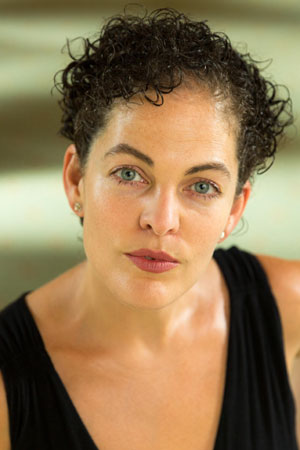
Shara McCallum
is the author of seven books published in the US
& UK, including Behold, No Ruined Stone, and Madwoman.
Recognition for her work includes a Guggenheim Fellowship, NEA
Poetry Fellowship, Musgrave Medal, OCM Bocas Poetry Prize,
Hurston/Wright Legacy Award, and others. From Jamaica, of
Jamaican and Venezuelan parentage, McCallum directs the Creative
Writing Program and teaches at Penn State, where she is a Sparks
Professor of English.
As previously, Shara was gracious enough to take the time to answer
a few questions about Behold.
This book seems more autobiographical than your
previous two. What led you to this more personal theme?
How does if fit with your other work?
You are the second person to ask me about autobiography in
conjunction with Behold. It makes sense since I’ve included prose
meditations that are clearly autobiographical and also have a series
of poems in the collection titled ‘Self-Portrait.’ Obviously, I’m
inviting the reader to see the “I” as “Shara,” at least in those pieces,
if not also others by extrapolation. I can’t really say what made me
write with more self-disclosure this go round, but I suspect aging
has something to do with the matter. As we get older, perhaps the
masks we’ve worn earlier in our lives don’t suit us as much or we get
tired of keeping them in place. In terms of your second question
here, I’ve long been interested in the self as a construct. Behold
comes out of and I hope extends that thread of enquiry from
previous books.
In “How to See” you write:
“When I decided to become a poet, it was after letting go
the paths—medicine or, if that failed, law—I was expected
to be on by attending university. Only then, when I saw I
was actually going to throw my life away, did I take two
art classes.”
So your interest in art began at the same time as you
decided to become a poet. How did you decide on poetry?
Actually, my interest in art (music, dance, painting, poetry, and
more) has been a constant my whole life. The piece you’re quoting
from is reflecting on a particular moment, when I was at university,
and saw very clearly that I was going to devote myself to trying to
make art. I saw that I would approach poetry not as a passing fancy
but as my avocation. I think like many people who write poems,
poetry partly decided on me. I also write essays but not nearly with
the same regularity nor near-compulsion I feel where poems are
concerned. What I love about poetry is its ability to create a musical,
metaphoric, mythic, memory-laden world, story, and speaking
voice. I also really revel in repetition. I’m the kind of person who
obsessively listens to one song or watches a show over and over
again. All art invites and rewards repeated engagement. Poetry has
repetition as a premium, as poems remake meaning with recursive
reading/listening.
The collection contains many ekphrastic poems along with
reminiscences about creating art yourself, visiting
museums, etc. As a follow up to the previous question,
why have you now decided to make art and your
experiences with it central to your poetry?
Again, this is a great question to which I’m not sure I have a precise
answer. I didn’t start the book with an idea of what it would be
about. I was lucky to have a fellowship that gave me a year away
from teaching, and I decided I would use that time to visit as many
museums as I could and seek out works by other Black, Caribbean,
Latin American, women artists and see what came of that. I really
love visiting museums, especially going by myself and wandering
around and looking at the art. I read the Romantic poets as a young
person and was deeply influenced by many of their thoughts on
poetry and life. The impressions they gave of the value of trying to
reach the Sublime resonated with me. I still very much want the
dailiness of my life to be punctured by something awe-inspiring.
Looking at art is one of the ways I experience the disruption of the
ordinary and of routines. Art makes me pay attention.
Madwomanand No Ruined Stone both draw on your racial
and ethnic heritage, particularly the Jamaican and
Scottish elements. How does Behold follow from those
books?
Those elements of my identity and my negotiations of history are
also throughout Behold. As Marley said and I love to quote: “you
can’t run away from yourself.” Nor am I trying to do so in Behold.
Often the opposite: I’m examining how I see myself and am seen,
now and in this political moment. I hope this book adds to the
question of inheritance I asked in my previous two, which you
mention. Many of the poems in Behold speak to my Jamaican &/vs.
American selves, to my ancestors, to migrations, colonisation, and
slavery, to violence and survival.
And finally, the word “behold” has clear biblical
connotations and you have an epigraph from The Book of
Hebrews at the beginning of the book. Could one say that Behold is in part a book of witnessing?
Thank you for this, Greg. Yes, I not only hope one could but that one
would say exactly what you are suggesting: Behold is about
witnessing. It’s ironic how much of my life I’ve spent trying to look
clearly and honestly—at the past, at others, at myself, at art
now…—and still feeling inadequate to the task.
|