|
Each
summer since 1991, the
Contemporary American
Theater Festival (CATF)
presents five plays,
many of them world
premieres, at Shepherd
University in
Shepherdstown, West
Virginia. On July 12,
2025, this reviewer saw Kevin
Kling: Unraveled and Did My Grandfather Kill My Grandfather.
Both were one-man plays
written and performed
by the same person.
Both dealt with
personal subject matter
and the theme of
fitting in with the
people around them.
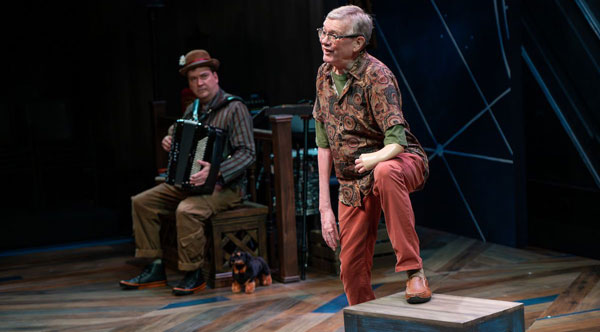
In Kevin Kling: Unraveled, writer/actor Kling shares the stage
with musician Robertson Witmer who underlays Kling’s stories
with musical sounds. Witmer employs instruments such as drums
(and other percussion instruments), accordion, and clarinet. At
the end of the play, Witmer and Kling sing together. Kling also
has help from stagehands, who walk on and off the set handing
things to him and positioning props. Kling’s life story revolves
around a congenital birth defect that gave him a left arm that is
three quarters the size of his right arm and with only four fingers
and no thumb or wrist. Additionally, Kling’s right arm is totally
paralyzed from a motorcycle accident he suffered as an adult.
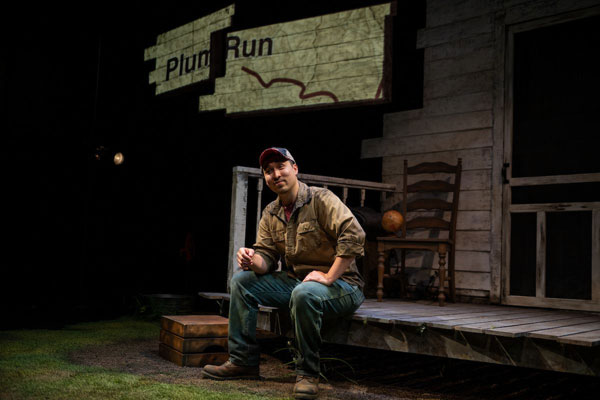
Did My Grandfather Kill My Grandfather by Cody Leroy Wilson
is a traditional one-man play, where Wilson tells his life story.
What makes this play unusual is that Cody Leroy Wilson was born
in a West Virginia holler to a mother from Vietnam but who never
spoke a word of Vietnamese or knew anything about the country
and its culture. She had been an orphaned infant brought to West
Virginia by an American soldier who took the child home to his
wife. Cody tells his audience that, until he went to school, he
didn’t know he was an Asian American. He thought he was
“white” like his grandparents.
Both plays have distinctive openings. Kling performs a tongue
-twisting rap that informs his audience that everyone is welcome
to hear his stories. It sets a standard for lyricism and delivery that
is impeccable throughout Kling’s play and no, this is not a
rapper’s telling. Kling is a master storyteller who is often heard on
National Public Radio’s All Things Considered.
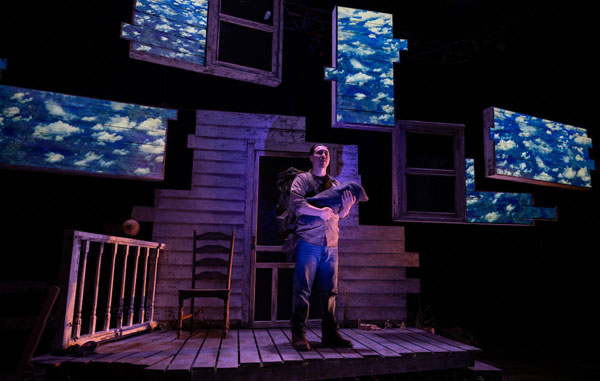
Cody Leroy Wilson opens his play by breaching the Fourth
Wall—he steps off the set and asks the audience, “Where are you
from” and listens to their answers. Then he moves back into the
set and tells his story, sometimes assuming the role of his white
grandfather.
Both plays are 90 minutes long with no intermission. Each of the
two plays uses sets in a distinctive way. The Grandfather play
employs a series of video screens to provide information (e.g.
maps) or natural imagery conveying time of day or season. The
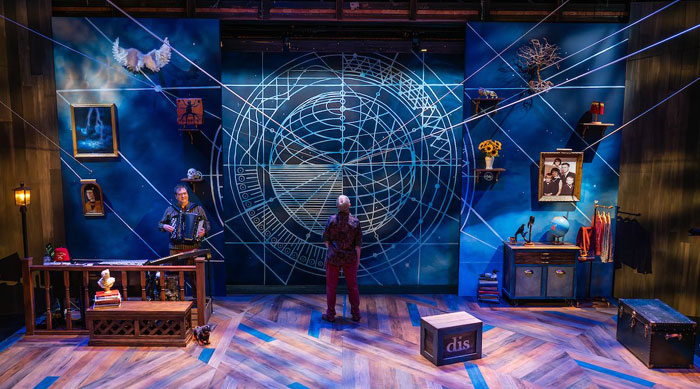
set of the Kling play operates at a subconscious level. The
audience might wonder, “What is that circular design on the back
wall with projecting strings tied into the ceiling?” It is something
that Kling himself contemplates during the play without
commentary. This reviewer’s thoughts drift to a Buddhist
mandala that represents cosmic unity, harmony, and balance—all
states of being that Kling aspires to for his life as a person with
troublesome upper body limbs. In the Unraveled set, scenic
designer David M. Barber also places a skull on a shelf to one side
of the mandala as if to suggest Shakespeare’s Yorick, the dead
jester of Hamlet. The job of a jester in Shakespeare’s time was to
connect the dots on life’s absurdities or oddities as does Kevin
Kling in Unraveled.
The 2025 Contemporary American Theater Festival runs from
July 11 through August 3 and features Kevin Kling: Unraveled in
sixteen performances and Did My Grandfather Kill My
Grandfather in 21 performances. If this reviewer had to choose
between these two plays, she would pick Kevin Kling: Unraveled
which balances the emotional load between levity and sorrow and
has not a single moment that stops the action.
Photos: Seth Freeman
|




 Writings


