|
The
recent election of Pope
Leo XIV was even more
unexpected than the
outcome of the papal
election depicted in
Edward Berger’s Conclave. We
will never know what
backstage dramas took
place to elevate
Cardinal Robert
Prevost, a Chicagoan
who spent decades as a
missionary bishop in
Peru, to the papacy,
when it was axiomatic
that a native of the
United States would
never be pope. But
the Oscar-winning
screenplay by Peter
Straughan, based on a
novel by Robert Harris,
gives us enticing,
alarming food for
speculation.
Conclave begins
with a scene straight
out of John Le Carre: a
black-clad figure walks
through dark streets
and tunnels, clutching
a sinister-looking
briefcase. Soon
he arrives at his
destination: the
building where the pope
lays dying. The
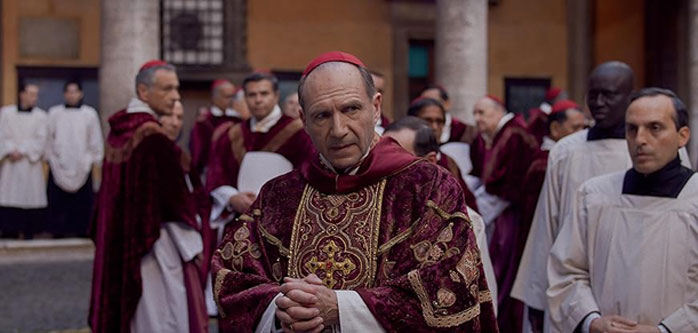
man is Cardinal Thomas
Lawrence (Ralph
Fiennes), dean of the
College of
Cardinals. Other
cardinals including
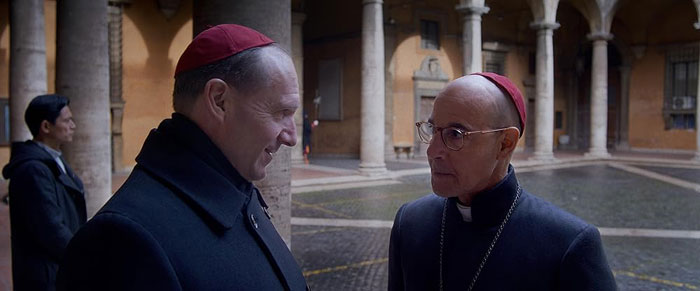
Aldo Bellini (Stanley
Tucci) and Joseph
Tremblay (John Lithgow)
are among those in
solemn attendance.
Lawrence and Bellini
were especially close
to the late pontiff and
share his progressive
agenda. Bellini
wants greater
acceptance of LGBTQ
Catholics, an expanded
role for women in the
Church, and “no
more families of ten
children because Mommy
and Daddy didn’t
know
better.” He
disavows any ambition
to be pope, but
Lawrence sees him as
the best bet against
archconservative bully
Goffredo Tedesco
(Sergio Castellito).
As dean, Lawrence is in
charge of organizing
the conclave. He
does so with a sense of
guilt: he did not part
friends with the old
pope, who was angered
by his request to
resign the
deanship.
Lawrence shares with
the pope a growing
sense of
doubt—not about
God, but about the
Church.
As cardinals arrive from around the world for sequestration
during the voting process, Lawrence receives distressing news
from Archbishop Wozniak (Jacek Koman): the pope’s last
meeting was with Tremblay, another likely candidate for the
papacy. The pope dismissed Tremblay from all his ecclesiastical
offices, for reasons Wozniak doesn’t know.
Events at the conclave become progressively more unsettling.
Cardinal Vincent Benitez (Carlos Diehz), whom the late pope
created Archbishop of Kabul in pectore (i.e. in secret), arrives at
the conclave to cast his vote. Bellini, who started out strongly in
the first ballot, loses ground to Tedesco. Conservative Nigerian
Cardinal Adeyemi (Lucian Msamati), another strong candidate,
has a public screaming match with a nun for what turn out to be
disturbing reasons. Lawrence, against his wishes, sees an
insurgency in his favor among Benitez and other cardinals.
These tangled webs roil the conclave up to the point that an act of
violence occurs—one that turns the story on its ear and leads to a
final twist.
The Catholic Church is the Western world’s oldest institution, and Conclave argues that consequently it is the Western world’s oldest
bureaucracy, for good and ill. All the actual business of the
Church seems to take place in whispers, in darkened corridors
and stairwells, in scenes reminiscent of the more hushed
sequences in The Godfather. That atmosphere, unfortunately,
is appropriate for thugs such as Tedesco and charlatans such as
Tremblay, who thrive in institutional sclerosis. But there are also
men such as Lawrence, Bellini, and Benitez, who take seriously
their status as men of God and never forget the needs of rank-and
-file believers.
But in the Catholic Church, the operant word for those in power is
“men.” This is particularly hard for Sister Agnes (Isabella
Rossellini), who watches the cardinals with silent disapproval,
knowing she is smarter and more capable than most of them.
Toward the end, Sister Agnes has her explosive say, unmasking
one of the story’s worst scoundrels for all the assembled clueless
men to hear.
Conclave immerses viewers in a world of rigid ceremony that too
often masks skullduggery and double-dealing. The cast—which
won the Screen Actors Guild Best Ensemble Award—is a marvel,
all actors deployed in roles that seem tailor-made for their
talents. Berger—a director who proved his visual flair in such
projects as Patrick Melrose and All Quiet on the Western
Front—works with cinematographer Stephane Fontaine and
production designer Suzie Davies to give the film a richly
foreboding look, punctuated by startling images such as the sea of
white umbrellas in a rain-soaked Vatican courtyard.
In Conclave, the most admirable characters are spiritual pilgrims
who seek to divine and perform God’s will in a church riddled
with corruption. David and Benji Kaplan, protagonists of Jesse
Eisenberg’s A Real Pain, are also pilgrims of a sort, but not
religious ones. “There but for the grace of no God go I,” David
(Eisenberg) says at one point. Instead, cousins David and Benji
(Kieran Culkin) seek many things at once—reconnection with
dead loved ones and each other, as well as coming to grips with
family, history, and survivors’ guilt.
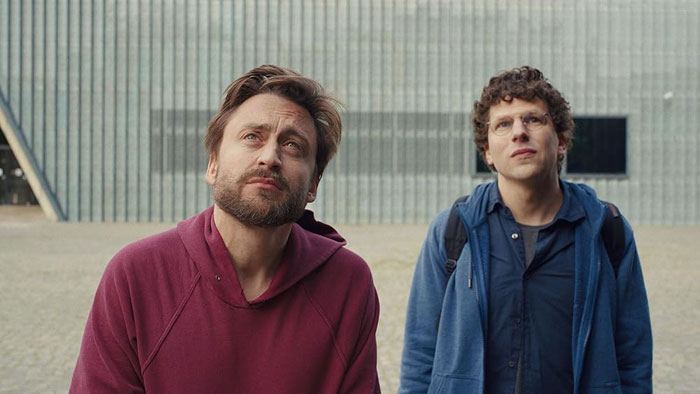
A Real Pain begins with David and Benji meeting at John F.
Kennedy Airport to fly to Poland. Their late grandmother left
money in her will for them to make the trip; they will take a
“Jewish history tour” of Warsaw, Lublin, and the former
concentration camp at Majdanek, then travel to the small town
where their grandmother lived to find her old house.
We see from the beginning that David and Benji are deeply
neurotic, though in starkly different ways. The tightly wound
David makes repeated phone calls to Benji on the way to the
airport, apologizing for being late; Benji, expansive and
passionate, is the sort who thinks it’s fine to put cartons of yogurt
in your pocket for safekeeping. He’s also the sort who mails
himself marijuana to his Warsaw hotel to ensure he and David
have good weed in Poland. David is proud of his job in digital ad
sales; Benji’s reaction to it is, “God, I hate that shit!”
In Warsaw, David and Benji meet their tour mates: Marcia
(Jennifer Grey), a woman coming off a brutal divorce; Eloge
(Kurt Egyiawan), a Jewish convert and survivor of the Rwandan
genocide; Mark (Daniel Oreskes) and Diane (Liza Sadovy), self
-styled “Mayflower Jews” whose ancestors immigrated long
before the Holocaust; and James (Will Sharpe), the tour guide
and the only non-Jew. It is one of the shrewdest features of
Eisenberg’s excellent screenplay that we get to know these people
just well enough. They are not ciphers, but they exist largely to
react to David and Benji, and their reactions tell us a great deal.
David interacts awkwardly with his tour mates, “I know you’re not
the most comfortable person with groups and people and shit,”
Benji tells him. Benji, on the other hand, quickly becomes the
group’s de facto leader. He berates James and the others about
their insensitivity. “We are Jews on a train in Poland!” he rants at
one point. “Does no one see the irony here?...Eighty years ago we
would have been herded into the back of this fucking thing like
cattle!” The others are disconcerted at first, but they eventually
warm to Benji’s ardent nature. At one point, Benji persuades the
others to make action poses in front of a war memorial. David
declines to pose and is left juggling everyone’s cell phones to take
pictures.

Each cousin wishes he were more like the other. “I love him, and I
hate him, and I want to kill him, and I want to be him!” David
says. As for Benji, he tells David, “You have a wife and a job. I
don’t really have anything going on.”
Essentially,A Real Pain is about two likable, deeply flawed men
who have difficulty living in the world. One is uncomfortable in
it, the other can’t find a place for himself at all. The title is a
multiple pun; both David and Benji can be a real pain, but they
also feel great pain, for obvious and overwhelming reasons. A
Real Pain reminds me of Kelly Reichardt’s Old Joy, about two old
friends reconnecting in an aura of sorrow, but A Real Pain has the
added theme of the Holocaust, which underlies and poisons
everything. The tour group’s visit to Majdanek emphasizes that
grief in a way you will never, and should never, forget.
Kieran Culkin’s performance as Benji swept the last awards
season and eminently deserved to, despite some formidable
competition. In some ways Culkin’s Benji is a variant on his other
most famous role, as Roman Roy on Succession. Both Benji and
Roman are profane, hyperactive live wires, their manic wit
masking deep insecurities. But Benji, unlike Roman, cannot
retreat into wealth and let others clean up the messes he makes.
(“Rich people are fucking idiots,” Benji says.) What Benji could
retreat into was the love of his grandmother, and without her
presence, he is lost. We ache for Benji as much as David does,
and get just as exasperated with him.
By design Eisenberg’s David isn’t as dazzling a character as Benji,
but Eisenberg still has many poignant moments as a man with a
constant, urgent need to protect himself. When David talks about
his little son’s obsession with tall buildings, you tell he identifies
with his son’s need to latch on to something solid.
No review of A Real Pain would be complete without mentioning
its soundtrack. The nocturnes and etudes of Chopin, the
composer who personifies Poland, accompany David and Benji’s
adventures. In interviews, Eisenberg said he intended Chopin’s
music to give a sophisticated counterpoint to its lead characters’
juvenile behavior. Personally, I see even more in Eisenberg’s
choice. I think that the melancholy inherent in Chopin’s music
underscores the melancholy inherent in David and Benji’s story,
and in Poland’s. During the tour, James notes that Warsaw is
often called “The Phoenix City” because it has arisen from the
ashes so many times. David and Benji’s grandmother fled the
ashes, and now David and Benji are left to deal with that history
as best they can. How successful they are can be judged by Benji,
whom we find at the end in exactly the same place he was at the
beginning.
|